Blipbug: Complete Guide to This Adorable Bug Pokémon and Its Evolutions
Blipbug is a charming Bug-type Pokémon introduced in the Galar region as part of Pokémon Sword and Shield. This tiny larva Pokémon captures the imagination of fans worldwide with its clever design, smart personality, and surprising strength in battles. Whether you’re a longtime trainer or a newcomer exploring the world of Pokémon GO, understanding blipbug is essential for building your team and completing your Pokédex. In this comprehensive 3000-word article, we’ll dive deep into every aspect of blipbug, from its origins and biology to gameplay strategies, evolutions, and more.
What Is Blipbug?
Blipbug (#824 in the National Pokédex) is officially classified as a Larva Pokémon. Its name combines “blip,” which refers to the short, sharp sound of radar detection or a small dot on a screen, with “bug,” a common shorthand for insect. This clever etymology perfectly describes the Pokémon’s role as an information collector. Fans often describe blipbug as the smartest Bug-type Pokémon in its early stages, despite its extremely low defensive stats.
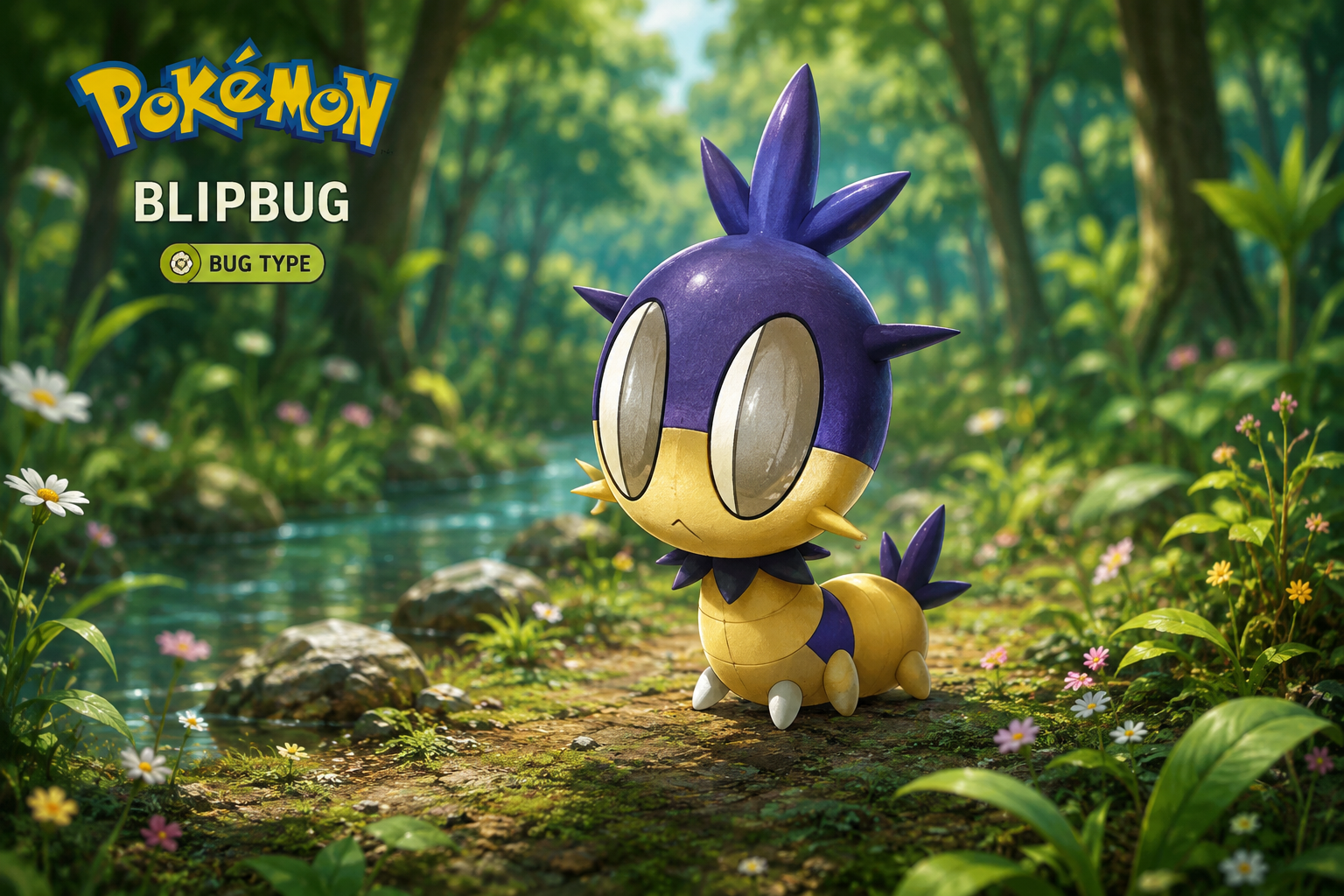
In the games, blipbug appears in the Galar region and has since become a staple in Pokémon GO through the Bug Out event. Its design is instantly recognizable: a small, ovular larva with a dark blue dorsal half and beige ventral half. Large, reflective eyes that look like tiny glasses give it a perpetually surprised expression. A blue collar-like segment sits on its body, adorned with yellow setae resembling a bow tie. The rest of its segmented body features white, yellow, and blue sections, with stubby legs and sensitive hairs all over.
This Pokémon is often found in gardens, where its setae help it sense its surroundings. Although it’s very weak in raw power, blipbug compensates with intelligence and adaptability. Its Pokédex entries highlight this perfectly: “A constant collector of information, this Pokémon is very smart. Very strong is what it isn’t.” In Pokémon Shield, another entry notes it’s commonly found in gardens, using body hairs to assess its environment.
Blipbug isn’t just cute—it’s a strategic choice for players who value utility over brute force. With the hidden ability Telepathy, it can even protect allies in double battles. If you’re wondering what makes blipbug special, it’s the perfect blend of cuteness, intelligence, and versatile typing.
Biology and Characteristics of Blipbug
Blipbug stands at a compact 0.4 meters (1’04”) tall and weighs 8.0 kg (17.6 lbs). Its five body segments are covered in sensitive setae that act like tiny sensors. These hairs allow blipbug to collect constant information about its environment, making it one of the smartest Pokémon of its size.
The Pokémon’s head is ovular, with the upper half dark blue and the lower half beige. Its large eyes, which resemble glasses, are prominent and reflective. Small mouth and eyebrow-like markings add to its surprised look. The second segment forms a blue collar, and the yellow setae there resemble a bow tie—clearly inspired by the intelligent “bookworm” or nerd archetype.
Its body is long and divided into thinner and thicker sections, ending in white, yellow, and blue segments. It has four stubby, peach-colored legs and tufts of setae on its head, collar, and posterior. These details make blipbug look like a living encyclopedia of nature.
Blipbug belongs to the Bug type, giving it unique resistances and weaknesses that players must consider. Its abilities include Swarm (boosts Bug moves when HP is low), Compound Eyes (increases move accuracy), and the hidden Telepathy (protects allies from friendly Pokémon’s moves in double battles). Base stats are modest: 25 HP, 20 Attack, 20 Defense, 25 Special Attack, 45 Special Defense, and 45 Speed. Total Base Stat (BST) of 180 is among the lowest for Bug-types, emphasizing its reliance on strategy rather than raw power.
Blipbug’s breeding group is Bug, with a 50% male to 50% female ratio. It takes 15 egg cycles to hatch. In the wild, it thrives in gardens and grassy areas, making it a common early-game encounter for trainers.
Origin and Name Meaning of Blipbug
The name blipbug has a fascinating origin. “Blip” comes from radar slang—a short, sharp sound or small dot indicating a target. “Bug” simply means insect. Together, they symbolize how blipbug constantly “blips” information from its surroundings using its setae.
Its Japanese name, サッチムシ (Satchimushi), combines “satchi” (sense/search) with “mushi” (bug). This reflects its role as an information-gathering Pokémon. Some designers drew inspiration from a ladybug larva—dark body, yellow markings—but added glasses-like eyes and a bow-tie collar to portray a scholarly, bookworm-like character. The Pokémon embodies the British phrase “bookworm,” meaning someone deeply immersed in books, which fits its smart personality and garden-dwelling habits.
Blipbug was introduced in Pokémon Sword and Shield as part of the Galar region, with appearances in routes, wild areas like the Slumbering Weald, and Max Raid Battles. Its design philosophy balances cuteness with utility, making it a fan favorite among Bug-type players.
Blipbug in the Games: Sword and Shield
In Pokémon Sword and Shield, blipbug serves as an early-game Bug-type starter alternative. You can encounter it on Routes 1 and 2, in the Slumbering Weald, and the Giant’s Cap. Max Raid Battles featuring blipbug occur in Bridge Field, Dappled Grove, Rolling Fields, and South Lake Miloch.
Blipbug evolves into Dottler at level 10 and then into Orbeetle at level 30. In Sword, its Pokédex entry emphasizes its intelligence. In Shield, it highlights its garden habitat and sensory hairs. Its base stats remain the same across versions, but its move pool and utility shine in battles.
Blipbug’s role in the games is as a fast, information-focused teammate rather than a tank. Players often use it in teams for its Compound Eyes accuracy boost and Telepathy protection.
Blipbug in Pokémon GO
Blipbug made its Pokémon GO debut during the March 2026 Bug Out event. It appears in one-star Raids and GO Pass rewards. Catching blipbug lets you add Dottler and Orbeetle to your Pokédex.
In Pokémon GO, blipbug has a base CP of 177–204 (222–256 in rain). Its best moveset includes Struggle Bug as the fast move and Struggle as the charged move. The Pokémon is still available in the wild since July 2026, making it a reliable addition to any Bug-type team.
Blipbug Evolutions: Dottler and Orbeetle
Blipbug’s evolution line is straightforward yet impactful. It evolves into Dottler after 25 Blipbug candies. Dottler then evolves into Orbeetle after 100 more candies. In Pokémon GO, this requires catching enough blipbug during the event.
Dottler evolves from blipbug at level 10 in main games. Orbeetle, the final form, gains Psychic typing and a Gigantamax form in some raids. Orbeetle’s Psychic moves and G-max form make it a powerhouse, but the line begins with blipbug’s intelligence.
Abilities, Moves, and Battle Strategy for Blipbug
Blipbug’s abilities are Swarm, Compound Eyes, and Telepathy. Compound Eyes boosts move accuracy, while Telepathy protects in doubles. Swarm powers up Bug moves at low HP.
In battles, use Struggle Bug for consistent Bug-type damage with status effects. Struggle as a charged move provides coverage. Blipbug struggles with low defenses, so pair it with a bulky teammate or use its speed and accuracy.
Where to Find Blipbug in the Games and Pokémon GO
In Sword/Shield, look on Routes 1–2, Slumbering Weald, and Giant’s Cap. In Pokémon GO, raid it during Bug Out or search in gardens post-2026. Max Raids offer the best chances.
Blipbug Weaknesses and Counters
Blipbug is weak to Fire, Flying, and Rock types. It resists Fighting and Grass. Use Fire or Flying Pokémon to handle it effectively.
Best Teams Featuring Blipbug
Include blipbug in teams with Psychic or Fire-types for coverage. Its Telepathy makes it great in doubles. Examples include pairs with Orbeetle or other Bug Pokémon.
Fun Facts and Trivia About Blipbug
- Blipbug has the lowest base Defense among Bug-types.
- Its bow-tie setae represent intelligence.
- In Pokémon GO, it debuted in the Bug Out event with other bugs.
Conclusion
Blipbug is more than just a cute Bug-type—it’s a symbol of smart strategy, information gathering, and fun evolution. From its radar-inspired name to its garden-habitat role, this Pokémon brings joy and utility to every trainer who catches one. Whether you’re battling in Pokémon GO, collecting in the games, or exploring its lore, blipbugs adds a special touch to your Pokédex. Evolve it into the powerful Orbeetle, use its abilities in creative teams, and never underestimate its smart brain. Blipbugs may be small, but its impact is huge. Catch it, train it, and enjoy the journey with this charming larva Pokémon.