ColecoVision: The Ultimate 1980s Arcade-Quality Home Console Guide
The ColecoVision stands as one of the most innovative and forward-thinking consoles of the early 1980s video game era. Launched in August 1982 by Coleco Industries, it brought arcade-like graphics, sound, and gameplay directly into living rooms, challenging the dominant Atari 2600 and Mattel Intellivision. With its superior hardware and massive library of ports and original titles, the ColecoVision sold over two million units in its brief run before the industry crash forced Coleco to abandon the platform. Today, retro enthusiasts still celebrate the ColecoVision for its technical brilliance, expandability, and influence on modern gaming. This complete guide covers its history, hardware, best games, accessories, modern revival, and why the ColecoVision remains a must-have for collectors and players alike.
The Birth of ColecoVision: From Pong Clones to Arcade Rivals
Coleco began its video game journey in 1976 with the Telstar series of dedicated Pong-style consoles. These simple systems sold millions but nearly bankrupted the company when the market shifted to programmable cartridges. By the early 1980s, Coleco had recovered through handheld electronic games and decided to re-enter the console market with something bigger.
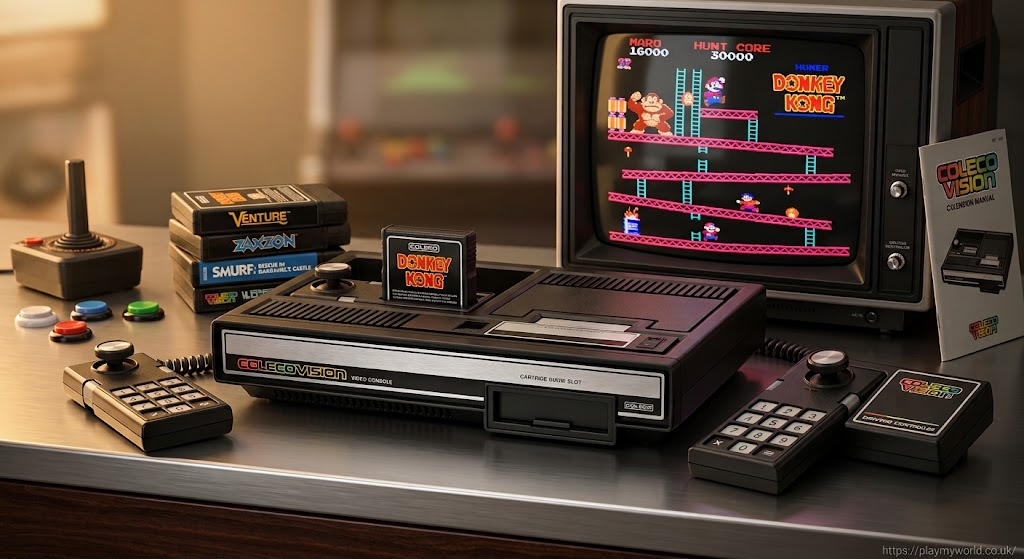
In 1981, Coleco executives approached Nintendo for the rights to the massive arcade hit Donkey Kong. The deal paid off handsomely: the ColecoVision launched with Donkey Kong as its pack-in game, a move that helped drive immediate sales. Released in North America in August 1982 at a retail price of around $199, the console quickly outsold competitors. By Christmas 1982, over 500,000 units sold, and it reached one million by early 1983. This success came despite fierce competition from Atari’s 5200 and the growing presence of home computers.
The ColecoVision’s timing was perfect. It arrived just as the industry was ready for a step up in graphics and power. Unlike the Atari 2600’s basic joystick and limited colors, the ColecoVision promised arcade-quality experiences that players could enjoy at home. Its short lifespan—discontinued in 1985—did not diminish its legacy. Instead, it became a symbol of what might have been if the 1983 video game crash had not occurred.
Hardware Specs: Why ColecoVision Outshone Its Rivals
The ColecoVision featured several groundbreaking specifications that set it apart from contemporaries:
- Processor: Zilog Z80A running at 3.58 MHz (four times faster than the Atari 2600’s 1.19 MHz).
- RAM: 8 KB, far more than the Atari 2600’s 128 bytes.
- Video System: Texas Instruments TMS9918A VDP with 16 KB of video RAM, supporting 256 x 192 resolution and up to 32 sprites on screen.
- Sound: Texas Instruments SN76489A programmable sound generator with three channels plus white noise.
- Storage: ROM cartridges ranging from 8 KB to 32 KB.
These specs delivered smoother gameplay, richer graphics, and more complex levels than anything available in 1982. The console supported up to 16 colors on screen simultaneously, creating vibrant environments that Atari’s limited palette could never match. The extra RAM allowed developers to implement advanced features like better collision detection, larger maps, and smoother animations. In short, the ColecoVision hardware was years ahead of its time, making it feel like a next-generation system when it launched.
The controller design also deserves mention. The standard roller controller combined a joystick with a numeric keypad, allowing for precise platforming and menu navigation. Later accessories expanded this further, but even stock, it offered more options than basic Atari or Intellivision controllers.
Key Features That Made the ColecoVision Special
One of the ColecoVision’s biggest advantages was its expandability. The console included an Expansion Module Interface on the front, which Coleco used to its advantage. Expansion Module #1 turned the system into a near-perfect Atari 2600 clone by housing a complete 2600 motherboard inside. This add-on gave owners access to the vast Atari 2600 library while keeping the superior ColecoVision hardware for native games. The result was the largest software selection of any console in 1982.
Other notable features included support for the Super Game Module (SGM), which added 16 KB of extra RAM and a second sound chip for dramatically improved performance. This mod was especially popular for arcade ports like Donkey Kong, allowing players to experience the full arcade experience at home. The console also supported multiple controller types, including steering wheels, light guns (in limited titles), and even the Roller Controller with its keypad for precision tasks.
These features made the ColecoVision feel like a developer’s dream machine. Creators could write games that pushed the hardware without worrying about memory constraints, resulting in some of the most polished ports of the era.
The Iconic ColecoVision Games: Top Picks for Retro Fans
The ColecoVision library boasts dozens of standout titles that showcase its arcade-quality heritage. Here are some of the most celebrated games:
Donkey Kong (1982, pack-in) – The definitive home version of Nintendo’s classic. The ColecoVision port features smoother animation and better color than many arcade versions, while preserving the core platforming challenge. It remains the best-selling game on the console and helped cement the ColecoVision’s reputation.
Zaxxon (1982) – Sega’s isometric shooter delivers stunning pseudo-3D graphics that look revolutionary in 1982. The ColecoVision version captures the arcade original’s sense of speed and scale, making it one of the console’s most innovative titles.
Gorf (1983) – A galactic space shooter with multiple game modes. Its ambitious design and smooth gameplay highlight the console’s power, and many fans rank it among the best arcade ports ever released.
BurgerTime (1983) – The fast-paced kitchen defense game translates perfectly, with smooth character movement and colorful visuals. Its addictive level design keeps players coming back for hours.
Frogger (1982) – A timeless arcade classic that captures the frantic crossing of traffic and rivers. The ColecoVision version is crisp and responsive, earning praise for its faithful adaptation.
Galaxian (1983) – Namco’s classic with colorful waves of enemies and kamikaze attacks. The ColecoVision enhances the original’s arcade feel with vibrant RGB colors and smooth sprite movement.
Other standouts include Centipede, Lady Bug, Miner 2049er, H.E.R.O., Pitfall II: Lost Caverns, Boulder Dash, Carnival, Frenzy, and Dragonfire. The library also includes original Coleco titles like 2010: The Graphic Action Game and ports of MSX games such as Popeye and Tapper. With around 140 official cartridges, the ColecoVision offered more variety than most contemporaries, and many ports remain superior to their Atari 2600 or Intellivision versions.
ColecoVision Accessories and Expansion Options
Coleco never skimped on extras. The SGM module added massive RAM boosts and extra sound, while Expansion Module #1 provided Atari compatibility. The Roller Controller became iconic for its unique keypad, and later models included steering wheels for racing games like Bump ’n’ Jump. Special controllers such as the Super Action Controller (with spinning wheels) and light guns enhanced gameplay for titles like Front Line and Time Pilot.
These accessories turned the ColecoVision into a highly versatile system. Collectors often seek complete sets including the console, cartridges, and mods for authentic play experiences.
The Impact of the 1983 Video Game Crash on ColecoVision
The video game market collapse of 1983 devastated the ColecoVision. Poor third-party quality, oversaturation, and the rise of home computers led to plummeting sales. Coleco attempted to pivot with the Coleco ADAM home computer, but its buggy design caused massive returns and financial losses. Production of the ColecoVision ended in 1984, with final units appearing in 1985. The crash prevented the console from reaching its potential as a third-generation leader.
Despite the failure, the ColecoVision still sold approximately 2 million units in North America alone, making it one of the better-selling second-generation consoles. Its short life did not erase its influence.
Legacy and Influence of the ColecoVision
The ColecoVision left a lasting mark on gaming. Nintendo used the console as a reference when designing the Famicom and later the NES, citing its graphics and sound capabilities. Sega originally planned to distribute the ColecoVision in Japan, influencing the company’s early arcade and console strategies. The console also pioneered the idea of cross-platform library sharing through the Atari expansion module, an innovation that later consoles would build upon.
In the retro gaming community, the ColecoVision is revered for its technical achievements and high-quality ports. Its success with Donkey Kong demonstrated how licensed arcade hits could drive console adoption, a lesson later used by Nintendo.
Modern Revival: Playing ColecoVision Today
Thanks to emulation, the ColecoVision lives on. Accurate emulators like MAME, Gearcoleco, ColEm, and ADAM+ allow players to run ROMs on modern computers, phones, and consoles. Many homebrew games and modern enhancements keep the spirit alive.
Physical revival includes miniature clones like the CV-NUC+ by MyTek, which packs original-era chips into a palm-sized form factor with SGM compatibility. The ColecoVision Full-Size Stand-Up Arcade Cabinet (released around 2024) features a 32-inch HD screen, authentic controls, and support for 40 classic games plus ROM uploads. These projects prove the ColecoVision’s hardware is still relevant and appreciated.
How to Play ColecoVision Games Today
Modern players have multiple options:
- Emulation – Free and highly accurate on PC, Raspberry Pi, or mobile devices.
- Physical Clones – Compact consoles that run original cartridges.
- Flashcarts – Devices that allow loading modern games or homebrew titles.
- Arcade Cabinets – Plug-and-play machines with built-in games.
Whether you prefer authentic 1980s hardware or contemporary setups, playing the ColecoVision is easier than ever.
Tips for Collecting and Preserving the ColecoVision
For collectors, focus on complete in-box sets, original cartridges, and rare accessories like the SGM. Test cartridges thoroughly for compatibility, as some require the SGM for full performance. Preserve the system with original manuals and dust covers. Join communities on forums and social media to trade games and learn about hidden titles.
FAQs
What is the ColecoVision console?
The ColecoVision is a second-generation home video game console released by Coleco Industries in 1982, known for its arcade-quality graphics, powerful hardware, and extensive library of games and ports.
How many games were released for the ColecoVision?
Approximately 140 official cartridges were published between 1982 and 1984, plus additional third-party titles, making it one of the most game-rich consoles of its time.
Can the ColecoVision play Atari 2600 games?
Yes, through the official Expansion Module #1, which turns the console into a near-complete Atari 2600 system, giving access to hundreds of 2600 titles.
What is the Super Game Module for ColecoVision?
The SGM is a hardware add-on that adds 16 KB of extra RAM and a second sound chip, significantly improving performance for many arcade ports.
Is there a modern ColecoVision clone?
Yes, the CV-NUC+ miniature clone by MyTek features original-era chips, built-in SGM support, and high compatibility, while full-size arcade cabinets with HD screens are also available.
How do I play ColecoVision games on a modern device?
Use accurate emulators like MAME, Gearcoleco, or ADAM+ on PC, or physical clones and flashcarts for authentic cartridge play.
Did the ColecoVision have any unique controllers?
Yes, the Roller Controller with its numeric keypad was standard, and special controllers included steering wheels and light guns for specific games.
Why did the ColecoVision stop being produced?
The 1983 video game crash, combined with Coleco’s failed pivot into the Coleco ADAM computer, led to the shutdown of video game production in 1984-1985.
Are ColecoVision games still fun today?
Absolutely. The arcade ports and original titles hold up exceptionally well, and the console’s hardware remains respected for its technical achievements.
What makes the ColecoVision different from the Atari 2600?
The ColecoVision offered far superior graphics (256×192 vs 160×192), more RAM, a faster CPU, and better sound, plus expandability that the Atari 2600 lacked.
Conclusion
The ColecoVision represents the golden era of console innovation when hardware pushed boundaries and games captured arcade magic. From its groundbreaking specs and expandable design to iconic ports like Donkey Kong and Zaxxon, this console delivered something special that few others matched. Though the 1983 crash cut its production short, the ColecoVision’s legacy endures through emulation, homebrew, and dedicated fans. Today, with modern clones and cabinets available, anyone can experience the arcade quality and excitement that made the ColecoVision a pioneer. Whether you are a longtime retro player or discovering it for the first time, the ColecoVision offers timeless entertainment that still feels fresh. Add one to your collection or fire up an emulator tonight—you will be glad you did.