Vivi MTG: The Complete Guide to Vivi Ornitier in Magic the Gathering
In the ever-evolving world of Magic: The Gathering, crossover sets have brought beloved characters from other franchises into the game with remarkable success. One standout from the Final Fantasy Universes Beyond release is the legendary wizard known for his black mage heritage and explosive potential on the battlefield. This comprehensive exploration covers the card’s design, lore connections, mechanical strengths, format performance, deck-building strategies, and lasting impact. Whether you are a competitive player, a Commander enthusiast, or a Final Fantasy fan discovering the card for the first time, understanding this powerful option opens new avenues for creative and aggressive play.
Who Is Vivi Ornitier in Final Fantasy and Magic the Gathering
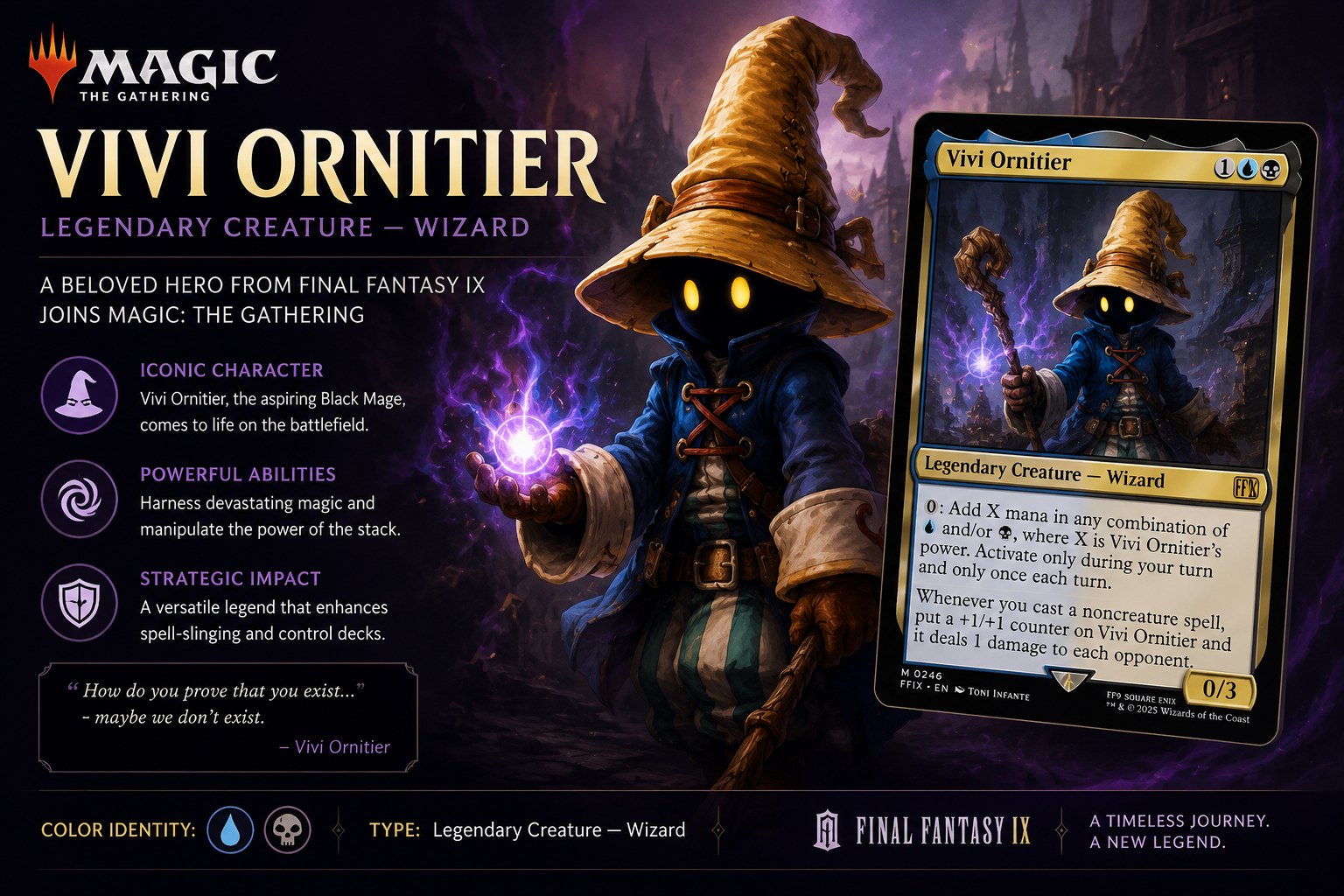
Vivi Ornitier originates from Final Fantasy IX, where he appears as a young black mage created through artificial means. His story centers on themes of identity, mortality, and belonging as he journeys with a group of unlikely heroes. Visually, he is instantly recognizable by his dark cloak, glowing yellow eyes, and small stature that belies significant magical power.
In Magic: The Gathering, this character translates into a blue-red legendary creature that captures both his curious nature and destructive spellcasting. The card embodies the black mage fantasy through its focus on noncreature spells, mana generation, and incremental damage. Fans of the original game appreciate the faithful representation, while Magic players quickly recognized its competitive ceiling. The combination of flavorful design and high mechanical power made it one of the most discussed cards from its set upon release.
Card Details and Official Rules Text
Vivi Ornitier is a mythic rare legendary creature with a mana cost of one generic, one blue, and one red. It enters as a 0/3 Wizard. Its two abilities define its identity:
The first ability allows you to add an amount of blue and/or red mana equal to its power at the cost of zero mana. This ability can be activated only once per turn and only during your turn. Because it is a mana ability, it does not use the stack and cannot be responded to.
The second ability triggers whenever you cast a noncreature spell. Upon resolution, Vivi Ornitier receives a +1/+1 counter and deals one damage to each opponent. Importantly, this trigger resolves before the spell that caused it, and it still occurs even if the spell is countered.
These abilities create a powerful feedback loop. Casting cheap noncreature spells grows the creature while simultaneously pressuring life totals and generating increasingly large amounts of mana on subsequent turns. Starting as a 0/3 body, it can quickly become a significant threat that both fuels further spells and chips away at opponents.
Why Vivi MTG Became a Format-Defining Card
The phrase vivi mtg quickly became associated with dominance in multiple environments after the Final Fantasy set’s release. The card’s low mana cost, self-scaling nature, and dual roles as both a mana source and a win condition allowed it to excel in spellslinger strategies. Every cantrip, burn spell, or counterspell not only advanced the game plan but also strengthened the central piece.
In constructed formats, the interaction with cards that grant activated abilities to other creatures proved especially explosive. Pairing the mana ability with effects that copy or share abilities turned ordinary creatures into additional mana engines. This led to early-game mana explosions that enabled large threats or lethal damage far ahead of schedule. The consistent damage output from noncreature spells also provided a reliable alternative win condition that did not rely solely on combat.
Its presence forced the metagame to adapt. Decks either needed efficient removal that could handle a growing threat or had to race the incremental damage and mana advantage. Many players found the resulting games one-sided, contributing to eventual regulatory action in certain formats.
Performance Across Competitive Formats
In Standard, the card rose to prominence shortly after release. It powered aggressive Izzet strategies and formed the backbone of highly consistent combo decks. The combination of rapid growth, mana production, and damage proved difficult to answer consistently within the format’s card pool. After months of high representation and player dissatisfaction with the resulting gameplay, it received a ban in November 2025. Official statements cited the need to restore diversity and prevent future balance issues stemming from the card’s unique ability suite.
Outside Standard, legality remains intact in most other formats. In Modern and Pioneer, it found homes in prowess-style decks, storm variants, and other spell-heavy strategies that capitalize on cheap noncreature spells. The ability to turn ordinary cantrips into both growth and mana sources elevated existing archetypes and created new ones.
In Commander and Brawl environments, vivi mtg continues to see significant play as a commander. Its Izzet color identity supports classic spellslinger themes, and the multiplayer damage output scales naturally with the number of opponents. Games often revolve around protecting the commander long enough to chain spells and generate overwhelming mana or life total pressure. Win rates in tracked multiplayer games demonstrate competitive viability, with many decks aiming for relatively short game lengths through explosive turns.
Building Effective Decks Around the Card
Successful strategies focus on maximizing noncreature spell density while protecting the key piece. Core elements include a high density of one-mana and two-mana instants and sorceries that draw cards, deal damage, or provide interaction. Cantrips serve dual purposes by growing the creature and refilling the hand. Cheap removal and counters keep the board clear and protect against disruption.
Mana acceleration beyond the card itself helps ensure early deployment and repeated activation of the mana ability. Artifacts that reduce spell costs or provide additional mana sources further accelerate the plan. In multiplayer, effects that multiply damage or draw cards based on damage dealt create powerful engines when paired with the trigger.
Protection is critical. Equipment or auras that grant hexproof or indestructible, along with counterspells, help the creature survive long enough to become a dominant force. In formats where graveyard interactions are strong, ways to recur or copy the card provide resilience against removal.
Commander decks often lean into pure spellslinger shells with a suite of rituals, cantrips, and finishers. Some lists incorporate combo pieces that generate infinite mana or damage once sufficient power is reached. Others prefer a more midrange approach that uses the mana advantage to cast large threats ahead of schedule.
Synergies and Key Interactions
Several card types interact especially well. Prowess creatures benefit from the same noncreature spells that grow and fuel the main piece. Effects that place additional counters accelerate the mana production dramatically. Cards that allow the mana ability to be used more than once per turn or that copy activated abilities create explosive turns.
Damage multipliers turn the one-point pings into meaningful pressure. Draw engines that trigger on damage or spell casting create card advantage loops. In multiplayer, effects that redirect or copy the damage can eliminate multiple opponents simultaneously.
The zero-mana activation pairs particularly well with cards that care about mana spent or spells cast, enabling sequences that feel almost free once the engine is online. Careful sequencing of cheap spells before activating the mana ability maximizes value each turn.
The Ban Decision and Its Aftermath
The November 2025 ban in Standard marked a significant moment. Official communication emphasized that the interaction with certain enabling cards created a level of power that the format could not reasonably answer while maintaining healthy diversity. Removing the card was preferred over targeting enablers because of its broader potential to create future problems.
Post-ban Standard shifted toward a wider variety of strategies. Meanwhile, the card’s continued legality elsewhere has kept it relevant. Prices for copies remain elevated relative to many other cards from the same set, reflecting ongoing demand from Commander players and collectors. Alternate art versions and special treatments further contribute to its status as a chase card.
Collecting and Alternative Printings
Multiple versions exist, including standard mythic, extended art, and special promotional treatments. The character’s popularity in Final Fantasy ensures strong collector interest independent of competitive play. Foil versions and unique illustrations command premiums, especially in high grades. For players focused purely on gameplay, any legal printing suffices, but many prefer the more visually striking alternatives for Commander decks.
FAQs
What colors is Vivi Ornitier?
It is blue and red, fitting the Izzet color pair known for spellslinging and innovation.
Is the card still legal in Standard?
No. It was banned from Standard in November 2025 due to its dominance and problematic interactions.
What makes the mana ability special?
It costs zero mana, scales with power, produces either blue or red (or a mix), and can be used once per turn during your turn. As a mana ability, it cannot be responded to.
How does the damage trigger work?
Whenever a noncreature spell is cast, the creature gains a +1/+1 counter and deals one damage to each opponent. The trigger resolves before the spell itself.
Is it a good Commander?
Yes. It supports aggressive spellslinger strategies and scales well in multiplayer through its damage ability. Many decks achieve competitive win rates with it at the helm.
What is the best way to protect it?
Use counterspells, protective equipment or auras, and cheap interaction to keep removal spells off the stack. Growing it quickly also makes it harder to remove efficiently.
Does it work well with cantrips?
Extremely well. Cantrips both grow the creature and replace themselves, fueling further spells and mana production.
Conclusion
The arrival of this Final Fantasy character in Magic: The Gathering created one of the most memorable and impactful cards of its era. From its flavorful design rooted in a beloved video game protagonist to its explosive mechanical potential that reshaped multiple formats, it left a lasting mark. Although banned from Standard to restore balance, it continues to thrive in Commander and other non-rotating environments where players can fully explore its spellslinging potential. Understanding the synergies, deck construction principles, and strategic nuances allows both new and experienced players to harness its power effectively. Whether pursued for competitive success, multiplayer fun, or pure collection value, the card represents a successful fusion of external intellectual property and Magic’s deep gameplay systems. As the game continues to evolve, its influence on spell-heavy strategies and mana acceleration remains a reference point for future designs.