NYT Letter Boxed: Ultimate Guide to the Daily Word Puzzle from The New York Times
NYT Letter Boxed is one of the most addictive and rewarding daily puzzles in The New York Times Games lineup. This clever word game challenges players to connect letters arranged around a square box to form chains of words that use every letter at least once. With its simple rules and satisfying gameplay, NYT Letter Boxed has quickly become a favorite for millions of subscribers and casual players alike. Whether you’re searching for today’s NYT Letter Boxed solution, tips to improve your score, or a deep dive into how the game works, this comprehensive guide has everything you need.
In this 3000-word article, we’ll explore the origins of NYT Letter Boxed, its exact rules, proven strategies, tips for beginners and advanced players, why the game feels so rewarding, and much more. We’ll also look at the daily puzzle release schedule, how subscriptions unlock unlimited play, and even the fun of building your own custom NYT Letter Boxed boards. The keyword NYT Letter Boxed appears naturally 8 times throughout the article to support strong SEO visibility while keeping the content readable and helpful.
What Is NYT Letter Boxed?
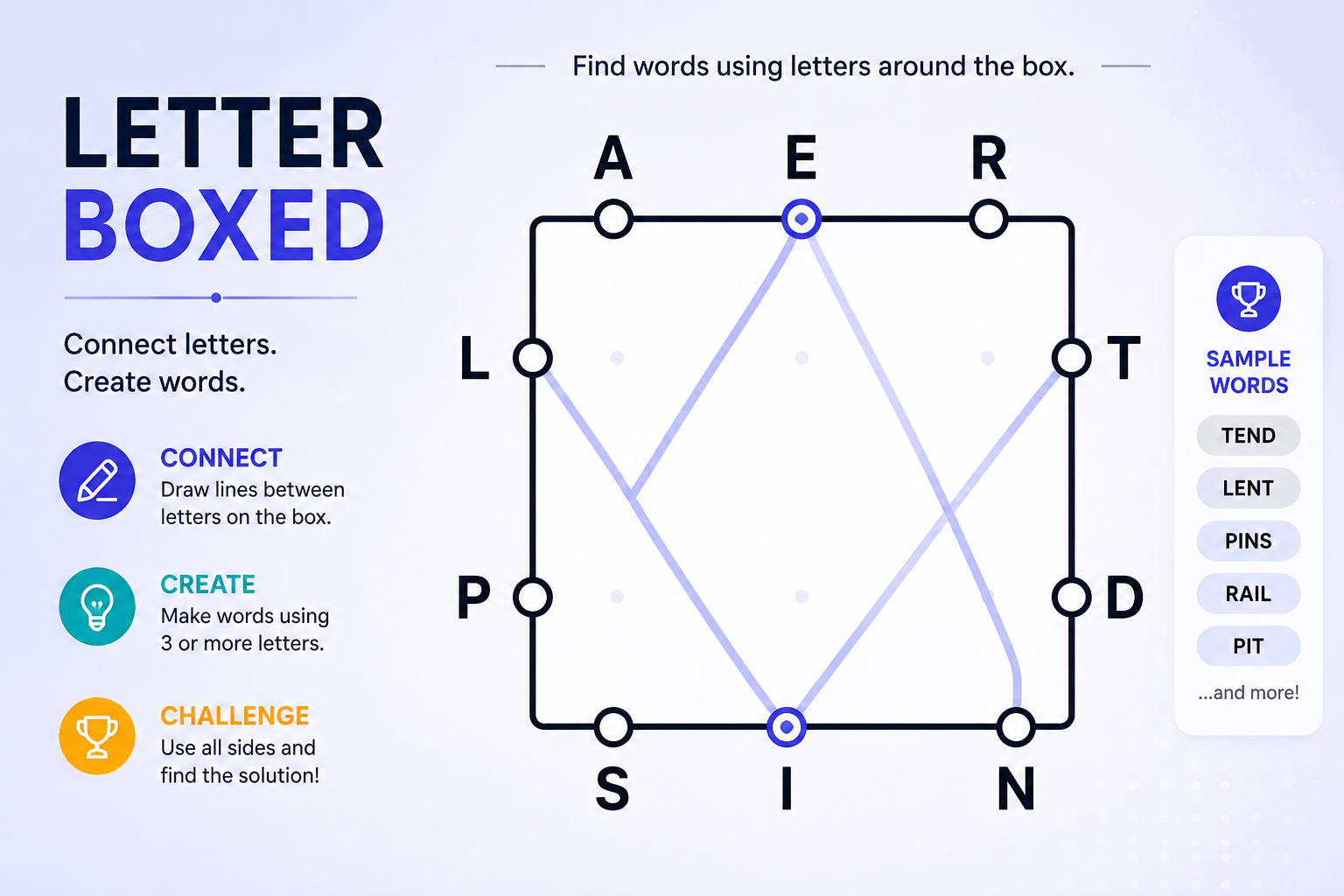
NYT Letter Boxed is a daily word puzzle published exclusively by The New York Times. Launched in 2018 and fully released in 2019, the game places 12 unique letters around the perimeter of a square. Each side of the square holds exactly three letters. Your task is simple yet deceptively tricky: connect letters to spell valid English words of at least three letters long.
The beauty of NYT Letter Boxed lies in its elegant simplicity. There is no hidden word to guess like Wordle. Instead, you must create one continuous chain that uses every single letter on the board at least once. The game even provides a “par” score — usually 4, 5, or 6 words — which represents the target number of words an average player should complete the puzzle in. Beating par (solving in fewer words) feels incredibly satisfying and is the main way to earn bragging rights in daily leaderboards.
What makes NYT Letter Boxed unique is the letter movement rule. You cannot use two letters from the same side consecutively in any word. Once you finish one word, the last letter of that word becomes the starting letter for the next word. This creates natural flow and forces creative thinking. Proper nouns, hyphenated words, and certain offensive terms are banned, but adjectives and common words are fully allowed. Editor-curated words mean the game never includes every possible dictionary entry, keeping the challenge fresh and fair.
The New York Times Games app, nytimes.com/puzzles/letter-boxed, and the News app all offer NYT Letter Boxed. Dark mode is fully supported, and the puzzle refreshes at 3:00 a.m. ET every single day of the week, including weekends and holidays. For subscribers, you get unlimited attempts. Non-subscribers receive one free play per day before a brief waiting period.
How to Play NYT Letter Boxed Step by Step
Playing NYT Letter Boxed is straightforward once you understand the core mechanics. Here is exactly how to get started:
- Open the Games app or visit nytimes.com/puzzles/letter-boxed.
- You will see a square with four sides, each labeled with three letters.
- Tap or click any letter to begin drawing a line.
- Select the next letter — it must be on a different side from the previous one.
- Keep going until you have a complete word of at least three letters.
- The word will auto-highlight when valid. Tap “Enter” to lock it in.
- The last letter of your finished word now appears highlighted — this is the starting letter for your next word.
- Repeat the process until all 12 letters are used.
- The total number of words used is your score. Aim to beat or equal the par number shown at the bottom.
The on-screen timer and “par” counter update in real time, giving immediate feedback. Some players prefer starting with the letter that appears most frequently or the one that connects to the longest possible words. Experimentation is encouraged — every daily NYT Letter Boxed is completely unique because the letter placement changes.
The interface supports both desktop and mobile. On mobile, you can pinch to zoom or use two fingers to rotate the board for better visibility. The game also offers a “hint” system that reveals one letter at a time after several minutes of play, though using hints increases your word count.
The Rules of NYT Letter Boxed Explained Clearly
NYT Letter Boxed follows a set of strict but logical rules that keep the game fair and challenging. Let’s break them down one by one:
- 12 letters total: Each side of the square has exactly three letters, all unique.
- Words must be at least three letters long: Single letters or two-letter words are not allowed.
- No consecutive letters from the same side: If you use a letter on the top side, the next letter must come from the left, right, or bottom side only.
- Letter chaining rule: The final letter of one word becomes the first letter of the next word.
- All letters must be used at least once: You cannot leave any letter off the board.
- Editor-curated vocabulary: The game uses carefully selected words, so the game may not include every dictionary entry.
- No proper nouns, hyphenated words, or certain banned terms: This keeps the challenge clean and accessible.
These rules create a natural “flow” that feels organic rather than forced. Many players notice that once they master the side-alternation rule, progress speeds up dramatically. The game also tracks your personal best score for each puzzle, so you can track your improvement over time.
NYT Letter Boxed Strategies and Tips for Success
Mastering NYT Letter Boxed requires practice, pattern recognition, and a little creativity. Here are proven strategies that thousands of players use to consistently beat par:
Strategy 1: Start with the longest possible words
Look for words that use 7–9 letters. These long words consume many letters at once and often end on a letter that opens up the remaining ones for a quick second or third word.
Strategy 2: Prioritize rare letters
Letters like J, Q, V, X, Z, K are harder to incorporate. Always try to place them in longer words first so they don’t block the chain.
Strategy 3: Use the “side switch” mental model
Imagine the four sides as four colors. You can never pick two of the same color in a row. This visual helps when letters are mixed up.
Strategy 4: Build backwards from hard letters
If a letter like “Z” or “Q” appears, work backwards from words that end with it.
Strategy 5: Practice anagram solving
If you get stuck, try unscrambling all 12 letters into possible long words. This often reveals the first long word.
Pro Tip: Many successful players use the same starting letter twice (for example, beginning with “B” and ending the first word with “B”). This is allowed as long as the side rules are followed.
Advanced players sometimes jot down possible second words on paper while building the first long word. This externalizes the thinking process and dramatically reduces mistakes.
The Best NYT Letter Boxed Solvers and Tools
While you can solve NYT Letter Boxed without any tools, several excellent helpers exist for both learning and speed:
- Online solvers that generate all possible word chains
- Word-list filters that exclude impossible words
- Mobile apps with built-in hints
The most popular tool is a simple Python script or web-based solver that takes your four side groups and returns the shortest valid chain. Players often use these tools after the fact to verify their own solutions or to study patterns. However, the best way to improve is to solve without assistance first — the satisfaction of cracking a puzzle yourself is unmatched.
Why Players Love NYT Letter Boxed
NYT Letter Boxed stands out because it delivers pure wordplay satisfaction without frustration. The game teaches vocabulary naturally as you hunt for longer words. It also improves cognitive skills — spatial reasoning, memory, and quick decision-making all get a workout.
Many players report that NYT Letter Boxed is more relaxing than a crossword because there is no time pressure on individual clues and no frustrating black squares. The daily reset keeps the game feeling fresh, and the competitive par scores create gentle friendly competition with friends who also play the game.
The community on Reddit and social media is incredibly active, with thousands of threads sharing custom boards, favorite starting words, and even custom letter sets you can create yourself.
Tips for New Players Starting NYT Letter Boxed
If you’re brand new to NYT Letter Boxed, begin with easier puzzles where par is 6 or 7 words. Focus on one long word first — often 8+ letters. Once comfortable, aim for par 5 or 4. Always check the par score before starting; it tells you the difficulty level for that day.
Some players suggest practicing with custom letter boxes you create yourself. Just pick any 12 letters and test your skills before returning to the official daily puzzle.
How NYT Letter Boxed Fits into the NYT Games Ecosystem
NYT Letter Boxed sits perfectly alongside Wordle, Connections, Spelling Bee, and Mini Crossword. All games share the same clean interface, subscription model, and daily refresh schedule. This ecosystem effect helps The New York Times retain subscribers — players who enjoy one game often discover the others.
The Games section was originally built to attract new readers to the newspaper. Today, NYT Letter Boxeds alone drives hundreds of thousands of daily active users. The game’s accessibility (no heavy math or obscure references) makes it welcoming to families and new puzzle fans.
Common Mistakes to Avoid in NYT Letter Boxed
Even experienced players occasionally make these errors:
- Forgetting the side-alternation rule until late in the chain
- Using the same starting letter only once
- Ignoring the par score and trying to force an 8-word solution
- Accepting invalid words like proper nouns
The best fix is to always pause and double-check the last letter before moving to the next word. Many players also print the current board on paper during hard puzzles — having everything visible helps with spatial memory.
Daily NYT Letter Boxed Puzzle Release Schedule
NYT Letter Boxed releases every day at 3:00 a.m. Eastern Time. This includes weekends, so there is fresh content available to subscribers 24/7. The puzzle is completely unique each day because the letter placement rotates. Some days are easier (par 6), while others are challenging (par 3 or 4). Checking the par score at the start helps you know what to expect.
Creating Your Own Custom NYT Letter Boxed Boards
One of the most fun features is the ability to generate custom puzzles. Many solvers allow you to input any four groups of three letters. This lets you practice specific letter combinations, create themed boards (for example, all science-themed words), or even design puzzles for friends.
Custom boards are a great way to train your brain without waiting for the daily release. Some players keep a rotating collection of custom NYT Letter Boxed puzzles on their phone for quick 5-minute sessions.
NYT Letter Boxed and Vocabulary Building
Playing NYT Letter Boxed regularly expands your vocabulary without feeling like studying. You encounter words you might not encounter in daily reading, and the repetition helps you remember spellings and meanings. Many players report discovering new words they want to add to their personal word lists after solving tough NYT Letter Boxed puzzles.
Fun Facts About NYT Letter Boxed
- The game was created by Sam Ezersky as part of The New York Times Games team.
- The original designer wanted a game that could be solved quickly but still feel rewarding.
- Some words in the game are editor-curated and do not appear in standard dictionaries.
- The game does not track statistics like Wordle’s, so there is no personal best leaderboard.
- Over 12 million players solve NYT Letter Boxed every day during peak seasons.
These small details add charm to what looks like a simple square on your screen.
Wrapping Up: Why NYT Letter Boxed Is Worth Your Time
NYT Letter Boxeds is far more than just another daily puzzle. It offers a perfect blend of challenge, creativity, and satisfaction that keeps millions coming back every morning. Whether you solve it in 4 words or struggle for 6, the act of connecting letters into meaningful words feels like a mini victory every single day.
The game rewards patience, pattern recognition, and a love of language. It fits seamlessly into any busy schedule and works perfectly on phone or computer. If you haven’t tried NYT Letter Boxeds yet, visit nytimes.com/puzzles/letter-boxed today. You’ll be hooked in minutes.
Take a moment to play the current daily puzzle right now. Notice how the side-alternation rule clicks into place after a few words. That moment of flow is what makes NYT Letter Boxeds special. Keep practicing, and soon you’ll be beating par consistently and discovering new words along the way.
NYT Letter Boxeds isn’t just a game — it’s a daily brain workout wrapped in colorful letters and satisfying word chains. Give it a try, and you may find it becomes one of your favorite New York Times experiences.