Shroodle: The Complete Guide to the Toxic Mouse Pokémon
In the expansive world of Pokémon Scarlet and Violet, few creatures capture the imagination quite like the tiny yet formidable Toxic Mouse Pokémon. This dual-type Poison and Normal species, known officially as the Toxic Mouse Pokémon, brings a unique blend of mellow charm and venomous defense to the Paldea region. Trainers seeking a versatile early- to mid-game companion will find this Pokémon both accessible and strategically rewarding as it develops into its evolved form. This comprehensive guide explores every aspect of the species, from its biology and battle capabilities to its design inspirations and practical tips for trainers.
What Is the Toxic Mouse Pokémon?
The Toxic Mouse Pokémon is a dual-type Poison/Normal Pokémon introduced in Generation IX with the release of Pokémon Scarlet and Violet. It holds the National Pokédex number 0944 and appears as number 202 in the Paldea Pokédex. Measuring just 0.2 meters (0.8 inches) in height and weighing only 0.7 kilograms (1.5 pounds), it ranks among the smallest Pokémon in its generation.
Its classification as the Toxic Mouse Pokémon reflects both its rodent-like appearance and its signature ability to produce a potent venom. The species maintains a calm, mellow disposition under normal circumstances. However, when provoked, it delivers a sharp bite using poison-coated front teeth capable of inducing paralysis. Territory marking forms another key behavior: the Pokémon secretes a poisonous liquid with a strong, unpleasant odor and uses it to paint warning marks around its nest, deterring potential intruders.
This combination of passive territorial defense and reactive venomous attack makes the species thematically consistent with real-world venomous shrews while fitting neatly into the Pokémon world’s creative ecosystem. It evolves into Grafaiai starting at level 28, transforming from a small shrew-like form into a more primate-inspired graffiti artist.
Appearance and Biology of the Toxic Mouse Pokémon
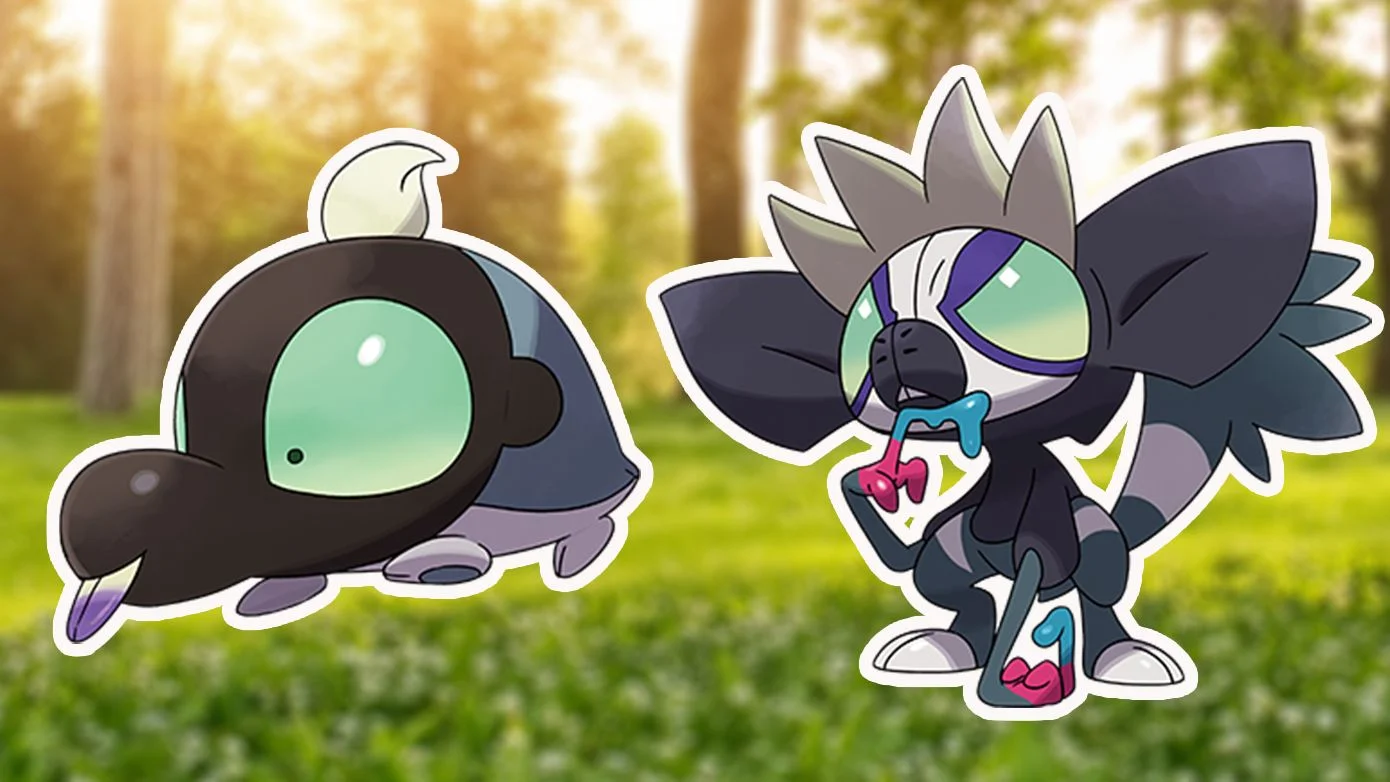
Visually, the Toxic Mouse Pokémon presents a compact, almost hemispherical body shape. Its fur is predominantly gray on the upper surfaces and white on the underside. A large black head occupies roughly half the body length, featuring large yellow-green eyes with tiny black pupils, small semicircular ears, a single tuft of blonde hair on top, and a prominent bulbous snout. The snout houses a pair of sharp upper incisors coated in purple poison. Four small white feet with gray paw pads and a short stubby tail complete the silhouette.
The biology of this species emphasizes both stealth and chemical warfare. Its small size and quiet nature allow it to remain relatively unnoticed in forested or bamboo-rich environments. When threatened, the poison delivered through its bite can paralyze the target, giving the Pokémon time to escape or further defend itself. The territorial paint it produces serves a dual purpose: the acrid smell warns other creatures, while the visual markings create a personal signature that evolves into the more elaborate artistic patterns of its final form.
In the wild, individuals of this species tend to inhabit areas near trees, particularly in central and surrounding provinces of Paldea. Their mellow baseline personality contrasts with the more mischievous and artistic tendencies that emerge after evolution, highlighting a clear developmental arc within the evolutionary line.
Base Stats and Abilities
Understanding the statistical profile is essential for any trainer planning to raise this Pokémon. The base stats are as follows:
- HP: 40
- Attack: 65
- Defense: 35
- Special Attack: 40
- Special Defense: 35
- Speed: 75
- Total: 290
These numbers reveal a glass-cannon profile focused on Speed and Attack. The relatively high Speed of 75 allows it to outpace many early-game threats, while the Attack of 65 provides respectable physical damage output. Defensive stats remain low, meaning the Pokémon relies on speed, status conditions, and strategic positioning rather than bulk.
Three abilities define its competitive and in-game potential. Unburden doubles the Pokémon’s Speed when its held item is consumed or lost. Pickpocket allows it to steal an opponent’s held item upon being hit by a contact move, provided the user itself holds no item. The hidden ability Prankster increases the priority of status moves by one stage, enabling faster setup or disruption tactics. These abilities, particularly Unburden and Prankster, open creative team-building opportunities, especially in formats that reward setup sweepers or priority status support.
Evolution into Grafaiai
The evolutionary path is straightforward yet transformative. The Toxic Mouse Pokémon evolves into Grafaiai upon reaching level 28. No special items, friendship thresholds, or time-of-day conditions are required. Trainers can accelerate the process through standard methods such as battling wild Pokémon, participating in Tera Raid Battles, challenging Team Star bases, or using Rare Candies and Exp. Candies.
Upon evolution, the base stats improve significantly: HP rises to 63, Attack to 95, Defense to 65, Special Attack to 80, Special Defense to 72, and Speed to 110, for a new total of 485. The design shifts from a small shrew-like form to a more upright, monkey-inspired creature with graffiti-artist motifs, including a hooded appearance and elongated fingers that drip poisonous saliva used for marking. This evolution also unlocks stronger moves and more refined ability synergy, particularly with Poison Touch on certain sets or continued Prankster support.
In Pokémon GO, the evolution requires 50 candies, and the species first appeared during the Fashion Week: Taken Over event in January 2025, primarily obtainable through 12 km eggs.
Where to Find the Toxic Mouse Pokémon in Paldea
Locating this species is relatively straightforward for explorers of the Paldea region. It appears in multiple provinces, often near trees or in forested and bamboo areas. Confirmed habitats include:
- South Province: Area One, Area Two, and Area Four
- East Province: Area One and Area Two, plus Tagtree Thicket
- West Province: Area Three
- North Province: Area One and Area Two
- Areas around Casseroya Lake
A fixed encounter can sometimes be found in South Province Area One. It also appears in 1-star Tera Raid Battles. Because of its small size and dark coloration, it can be easy to overlook at night, yet its non-aggressive temperament means it rarely flees on sight, giving trainers a fair chance to engage.
In Pokémon Legends: Z-A, it appears in Hyperspace Lumiose under certain conditions. Availability in Pokémon GO centers on egg hatching from Team Rocket Leader rewards.
Moveset and Battle Strategy
The level-up moveset emphasizes physical attacks and status disruption. Key moves learned include Scratch and Leer at level 1, Acid Spray at level 5, Bite and Fury Swipes at level 8, Switcheroo at level 11, Poison Fang at level 14, Flatter at level 18, Slash at level 21, U-turn at level 25, Poison Jab at level 29, Taunt at level 33, Substitute at level 36, Knock Off at level 40, and Gunk Shot at level 45.
Egg moves expand options further with Copycat, Cross Poison, Parting Shot, Super Fang, Swagger, and Toxic. Technical Machines provide access to useful coverage such as Acrobatics, Thief, Trailblaze, Facade, Venoshock, Dig, Swords Dance, Sludge Bomb, and Double-Edge.
In competitive formats, particularly Little Cup, an Unburden sweeper set has proven effective. Holding a Grassy Seed in Grassy Terrain triggers both a Defense boost and the Unburden Speed doubling. Swords Dance raises Attack, while Gunk Shot or Double-Edge delivers powerful STAB damage. Knock Off removes items from defensive walls, and Acrobatics gains power once the item is consumed. This approach allows the Pokémon to outspeed and threaten many common Little Cup threats after proper setup.
In the main story, a balanced physical set focusing on Poison Jab, U-turn, Knock Off, and a coverage move works well for mid-game progression. Status options such as Toxic or Taunt add utility against bulkier opponents.
Design Origins and Cultural Inspirations
The design draws from multiple real-world and cultural sources. Biologically, it references the Iberian shrew or Pyrenean desman, both native to the Iberian Peninsula that inspired Paldea. Certain shrew species possess venomous bites used to paralyze prey, directly paralleling the Pokémon’s paralysis-inducing attack. Elements of treeshrews and mouse lemurs may also influence the large eyes and evolutionary trajectory toward a more primate-like form.
The name combines “shrew” with “doodle,” reflecting both the animal basis and the artistic marking behavior that becomes central after evolution. The Japanese name Shirushrew incorporates words for juice, mark or sign, and shrew, reinforcing the territorial painting theme.
A notable cultural nod appears in the overall shape and the evolved form’s graffiti motif, which some observers link to the classic “Kilroy was here” drawings popularized during World War II. Grafaiai’s design further incorporates the aye-aye’s elongated middle finger, repurposed as a painting tool that applies colored poisonous saliva whose hue depends on the Pokémon’s diet. The painted trees of Tagtree Thicket evoke real-world installations such as the painted forest of Oma in Spain’s Basque region, blending modern street art with ancient human marking traditions.
These layered inspirations create a cohesive evolutionary story: a small, territorial shrew that marks its space with scent and simple signs grows into a deliberate graffiti artist leaving unique, personal patterns throughout its territory.
Competitive Role and Team Synergy
Beyond the main story, the species finds niche success in lower-tier competitive play. Its Speed and access to priority status moves via Prankster, combined with Unburden’s explosive potential, allow it to function as a setup sweeper or disruptive pivot. Team support often includes Pokémon that set Grassy Terrain to activate Grassy Seed, such as certain Grass-types, while partners that pressure Ground-types help cover weaknesses.
Type advantages include resistances to Grass, Bug, Fairy, and Poison, plus an immunity to Ghost. Weaknesses to Ground and Psychic require careful switching. The dual Poison/Normal typing is unique to this evolutionary line, granting exclusive STAB options that few other Pokémon can claim.
In casual play, the Pokémon’s charming design and straightforward evolution path make it a favorite among collectors and story-focused trainers. Its presence in Tera Raids and egg pools further expands accessibility across different game modes.
FAQs
What type is the Toxic Mouse Pokémon?
It is a dual Poison and Normal type.
At what level does it evolve?
It evolves into Grafaiai starting at level 28.
Where can I find it in Pokémon Scarlet and Violet?
Look in forested and tree-adjacent areas across South, East, West, and North Provinces, especially Tagtree Thicket and South Province Area One.
What are its abilities?
Unburden and Pickpocket are the standard abilities, with Prankster as the hidden ability.
Is it good for competitive play?
It has a viable niche in Little Cup as an Unburden sweeper and can serve supporting roles with Prankster in other formats.
What inspired its design?
Primarily venomous shrews of the Iberian Peninsula, combined with doodling and graffiti themes that develop fully in its evolution.
Does it appear in Pokémon GO?
Yes, it was released in January 2025 and can be obtained from 12 km eggs, evolving with 50 candies.
What are its base stats?
HP 40, Attack 65, Defense 35, Special Attack 40, Special Defense 35, Speed 75, for a total of 290.
Conclusion
The Toxic Mouse Pokémon stands as a memorable addition to Generation IX, blending approachable early availability with strategic depth and a charming evolutionary narrative. From its humble shrew-like form to its artistic Grafaiai transformation, this line offers trainers a journey of growth and personality. Whether raised for story, collected for the Pokédex, or optimized competitively, this species rewards understanding its unique abilities and typing. By understanding its biology, locations, moveset, and design roots, trainers can fully appreciate its role within the rich Pokémon world.