The Complete Guide to Kalashtar: History, Culture, Abilities and Roleplaying in Dungeons & Dragons
In the rich tapestry of Dungeons & Dragons campaign settings, few races capture the imagination quite like the kalashtar. Born from the fusion of human hosts and renegade spirits from the plane of dreams, these beings embody a unique blend of compassion, discipline, and otherworldly insight. This comprehensive article explores every major aspect of the race, from their ancient origins in the Eberron setting to their mechanical traits in fifth edition, cultural practices, and practical advice for players and Dungeon Masters. Whether you are creating a new character, planning a campaign, or simply curious about this distinctive people, the following pages provide a thorough and accessible overview.
The kalashtar stand apart from other humanoid races because they are a true compound species. Neither fully human nor fully spirit, they carry the legacy of a desperate escape from the nightmare realm of Dal Quor. Their story is one of resistance, spiritual purpose, and the quiet struggle to remain connected to both the material world and the light they serve.
Origins and Historical Background
Roughly eighteen hundred years before the present era of most Eberron campaigns, a group of sixty-seven quori spirits fled the plane of Dal Quor. These spirits rejected the oppressive rule of the Dreaming Dark, the dominant force that seeks to impose a shared nightmare upon all dreaming minds. Led by the kalaraq quori known as Taratai, the refugees searched for a way to escape permanent destruction.
They found sanctuary among the human monks of the Haztaratain Monastery in the mountainous nation of Adar on the continent of Sarlona. The senior monk Hazgaal and his students agreed to a permanent spiritual merging. The resulting beings became the first members of a new race. Over successive generations the bond became hereditary. Today every individual inherits a fragment of one of the original sixty-seven spirits, shared among an entire bloodline.
This history shapes every aspect of kalashtar existence. The memory of persecution by the Dreaming Dark and its agents, the Inspired of Riedra, remains a living force. Many still dwell in the fortified temple-keeps of Adar, while others travel the wider world of Eberron to further the cause of light and oppose the influence of nightmare.
Physical Appearance and Distinguishing Traits
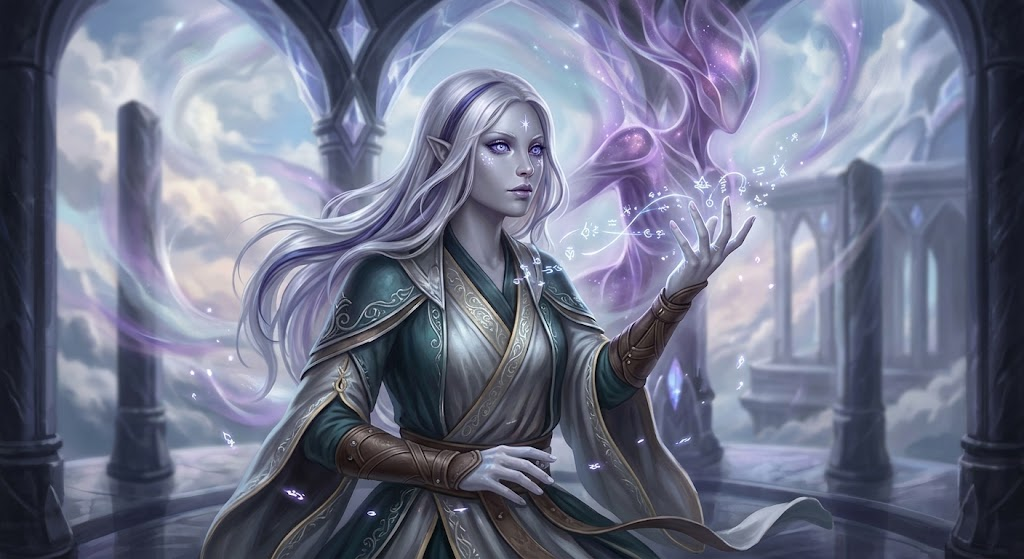
At first glance the kalashtar closely resemble humans. They share the same broad range of skin tones, hair colors, and eye colors. Closer observation reveals subtle differences. Most are slightly taller and more slender than average humans. Their facial features tend toward symmetry and gentle angularity, creating an impression of refined elegance that some observers describe as almost too perfect.
The most distinctive visual cue appears when a kalashtar experiences strong emotion or deep concentration: their eyes often emit a soft inner glow. Combined with graceful posture and measured movement, this quality gives them an unmistakable presence. Despite these traits, they can usually pass among ordinary human populations without immediate detection, an advantage for those who live in hiding from the agents of the Dreaming Dark.
Lifespan and rate of maturation match those of humans. Physically they experience the same cycles of growth, aging, and eventual decline. The difference lies entirely in the dual nature of mind and spirit that accompanies them from birth.
Personality, Dual Nature, and Inner Life
Most kalashtar feel a strong pull toward discipline, compassion, and purposeful action. The noble spirit bound to each individual encourages lawful and good tendencies. Self-control, empathy for other sentient beings, and a sense of higher mission are common traits. At the same time, the dual consciousness creates a mild sense of detachment. Many appear thoughtful, reserved, or slightly distant, as though part of their attention remains turned inward.
Children of the race often display these differences most clearly. They tend to be quieter, more observant, and quicker to accept responsibility than human peers of the same age. As they mature, individuals learn to integrate the human and spiritual aspects of their nature. A minority actively resist the influence of their spirit, choosing personal freedom over the path of light. Such choices generate rich internal conflict that players can explore in depth.
The inability to communicate directly with the bound quori spirit adds another layer of mystery. Inspiration, instinct, and dream-like memories are the primary channels through which the spirit makes itself known. These subtle influences can manifest as sudden insights, moral urgings, or fragmentary visions of events from the spirit’s long existence.
Culture, Society, and the Path of Light
Kalashtar society centers on the Path of Light, a philosophical and spiritual tradition dedicated to strengthening the force of positive energy known as il-Yannah, or the Great Light. Through meditation, disciplined living, and acts of goodness, adherents believe they can gradually shift the balance of Dal Quor itself away from nightmare and toward a more harmonious state.
Communities organize around lineages, each linked to one of the original sixty-seven quori. Names commonly combine a personal element with the name of the ancestral spirit, producing distinctive appellations that signal lineage affiliation. Daily life in the temple-keeps of Adar emphasizes martial training, mental discipline, communal responsibility, and constant vigilance against external threats.
Although many remain in the relative safety of Adar, others travel outward. Some serve as advisors, healers, or quiet agents in the nations of Khorvaire. Others actively hunt the influence of the Dreaming Dark wherever it appears. The tension between isolation for survival and engagement with the wider world forms a recurring theme in their collective experience.
Family structures and child-rearing practices reflect the importance of lineage. Children often receive guidance from multiple members of the same spiritual line, reinforcing the shared bond that defines their identity.
Mechanical Traits in Dungeons & Dragons Fifth Edition
In the fifth edition rules presented in Eberron: Rising from the Last War, the kalashtar receive a clear set of racial features that reflect their dual nature.
Ability Score Increase grants +2 Wisdom and +1 Charisma. These bonuses support classes that rely on either mental attribute for spellcasting or social effectiveness.
Dual Mind provides advantage on all Wisdom saving throws, a powerful defensive benefit against many charm, fear, and other mental effects.
Mental Discipline confers resistance to psychic damage, protecting against an uncommon but often devastating damage type.
Mind Link allows telepathic communication with any creature the character can see within a range of ten feet times the character’s level. The target must understand at least one language, but a shared language is not required. This ability opens numerous tactical and roleplaying possibilities.
Severed from Dreams means that while the character still requires sleep, their mind does not connect to the plane of dreams. Instead it draws upon the memories of the bound spirit. As a result, the character is immune to effects that require dreaming, such as the Dream spell, while remaining vulnerable to effects that simply induce sleep.
These traits combine strong mental defenses with flexible communication options. With the optional custom origin rules, players can redistribute ability score increases to better suit martial or hybrid builds.
Roleplaying Opportunities and Character Concepts
Playing a kalashtar offers abundant material for nuanced characterization. Possible concepts include the contemplative monk dedicated to spreading the Path of Light, the undercover operative living among ordinary citizens, the reluctant warrior driven by ancestral duty, or the individual who questions or even rejects the influence of their spirit.
Telepathy enables subtle coordination with allies and the ability to communicate across language barriers. The resistance to mental effects makes the race particularly resilient in campaigns featuring heavy use of enchantment or psychic adversaries. Dream immunity can serve as both a plot device and a source of isolation, since the character never shares the common human experience of ordinary dreams.
Players should decide early how strongly the spirit influences daily behavior. A character who fully embraces the Path of Light will behave differently from one who treats the spirit as a distant and sometimes unwelcome companion. The shared nature of each lineage also provides ready-made connections to other members of the same bloodline, whether as allies, mentors, or sources of obligation.
Integration into Eberron Campaigns
In an Eberron campaign the kalashtar function as natural opponents of the Dreaming Dark and the Inspired. Their presence immediately introduces themes of hidden war, spiritual conflict, and the thin boundary between the material world and the plane of dreams. Dungeon Masters can use them to seed long-term plot threads involving possession, prophetic visions, or the gradual struggle to change the nature of Dal Quor.
Even in non-Eberron settings the race can be adapted with minimal adjustment. The core concept of humans voluntarily bonded to benevolent dream spirits remains compelling in almost any fantasy world that includes planes of existence and mental magic.
Comparisons with Other Races
Compared with ordinary humans, the kalashtar possess greater mental fortitude and an inherent sense of purpose, but they often lack the sheer adaptability and numerical presence of humanity. Relative to other spiritually touched or psionic races, they stand out for their clear moral orientation and their specific connection to the realm of dreams rather than to more general psychic phenomena.
Their elegance and reserve can create interesting social dynamics with more boisterous or emotionally expressive races. The combination of human familiarity and subtle alien quality makes them excellent bridge characters between ordinary society and more exotic elements of a campaign world.
Practical Advice for Players and Dungeon Masters
When building a character, establish the name and general personality of the bound spirit early. Even limited details enrich roleplaying. Consider how the character’s lineage affects their goals and relationships. Decide whether the individual lives openly or conceals their nature for safety.
Dungeon Masters should treat the Dreaming Dark as a patient, intelligent, and far-reaching antagonist. Direct confrontation may be rare; more often the conflict appears through agents, dreams inflicted on others, or subtle political manipulation. Granting a kalashtar player occasional fragmentary visions or moral promptings from their spirit can deepen immersion without removing player agency.
Balance the race’s defensive strengths by presenting challenges that test other aspects of the character, such as physical endurance, social navigation in hostile environments, or difficult ethical choices that pit personal survival against the greater mission of the Path of Light.
Expanding Lore and Campaign Hooks
Possible adventure seeds include recovering a lost lineage whose spirit is fading, protecting a newborn whose unique connection threatens the plans of the Inspired, mediating between isolated temple-keeps and expansionist neighbors, or investigating a series of dream-related incidents that suggest the Dreaming Dark is probing for weaknesses. A character might also seek a way to strengthen communication with their spirit or to free a captured relative from Inspired control.
These hooks allow the race’s background to drive ongoing narrative rather than remaining mere flavor text.
FAQs
What exactly are the kalashtar?
They are a compound race formed by the permanent merging of human hosts with renegade good-aligned quori spirits from the plane of dreams.
Where do they primarily live?
Many reside in the fortified temple-keeps of Adar on the continent of Sarlona, though individuals and small groups can be found throughout Eberron.
Can they dream like ordinary people?
No. Their minds remain severed from Dal Quor and instead draw upon the memories of their bound spirit during sleep.
Are all members of the race good-aligned?
The bound spirits strongly encourage lawful and good behavior, but individuals retain free will and some resist that influence.
How does the telepathic ability work?
A character can communicate telepathically with any visible creature within a range of ten feet multiplied by the character’s level, provided the target understands at least one language.
Do they have unique naming conventions?
Yes. Names typically combine a personal element with the name of the ancestral quori spirit shared by the lineage.
Is the race suitable for martial classes?
With custom origin rules that allow flexible ability score placement, they can function effectively in martial roles while retaining strong mental defenses.
Conclusion
The kalashtar represent one of the most distinctive and thematically rich races available in Dungeons & Dragons. Their origin story of willing sacrifice and ongoing spiritual resistance provides a powerful foundation for both character development and campaign design. The combination of elegant physical presence, disciplined culture, and mechanically meaningful mental abilities makes them rewarding to play and compelling to encounter. From the remote temple-keeps of Adar to the bustling streets of Khorvaire’s great cities, these children of two worlds continue their quiet, determined work on behalf of the light. Understanding their history, values, and capabilities allows players and Dungeon Masters alike to bring greater depth and authenticity to any story that includes them. Whether serving as protagonists, allies, or enigmatic figures on the periphery of larger events, the kalashtar enrich the game with themes of identity, purpose, and the enduring struggle between dream and nightmare.