Complete Guide to Hungry Hungry Hippos: The Classic Marble-Munching Board Game
Few children’s board games capture pure chaotic energy quite like hungry hungry hippos. First introduced to American audiences in 1978, this fast-paced tabletop experience has entertained generations with its simple yet thrilling premise: colorful plastic hippos competing to gobble the most marbles. The game requires no complex strategy cards or lengthy rulebooks, relying instead on speed, timing, and enthusiastic button-mashing. Its enduring popularity stems from short play sessions, loud laughter, and the satisfying mechanical action of hippos lunging forward. This comprehensive article explores the history, components, rules, variations, strategies, cultural influence, and practical tips surrounding hungry hungry hippos, offering everything needed to appreciate and master this timeless favorite.
History and Origins of the Game
The roots of hungry hungry hippos trace back further than its 1978 U.S. debut. Toy inventor Fred Kroll, a World War II veteran who had previously worked with the Pressman Toy Corporation and contributed to the game Trouble, encountered a similar Japanese product made by the Agatsuma company during a business trip in the 1970s. Recognizing its potential, Kroll secured international licensing rights and later transferred them to Milton Bradley, a brand that would eventually become part of Hasbro. The game launched in time for the 1978 holiday season and quickly became a commercial success amid competition from electronic toys of the era.
Early marketing emphasized the frantic fun of the “marble-munching” action. Television commercials featured animated hippos and a memorable jingle that many adults still recall decades later. The original hippos carried distinct names and colors: variations included Happy or Lizzie (often purple or pink), Henry (orange), Homer or Home (green), and Harry (yellow). Over successive reprints the names and color schemes evolved. Later editions introduced pastel tones and names such as Sweetie Potamus, Bottomless Potamus, Veggie Potamus, and Hungry Hippo. Despite these cosmetic updates, the core mechanical design remained remarkably consistent.
Evolution Across Decades
Throughout the 1980s and 1990s the game stayed in continuous production. Special editions appeared under marketing banners such as Elefun and Friends alongside other action-oriented titles. Travel versions, water-play splash editions, and oversized arcade machines expanded the concept. In more recent years Hasbro has released refreshed packaging and slightly redesigned bases that allow easier storage while preserving the classic play experience. Real-life adult events, including ice-rink versions in certain cities, demonstrate how the game’s playful spirit transcends age groups.
Components and Setup
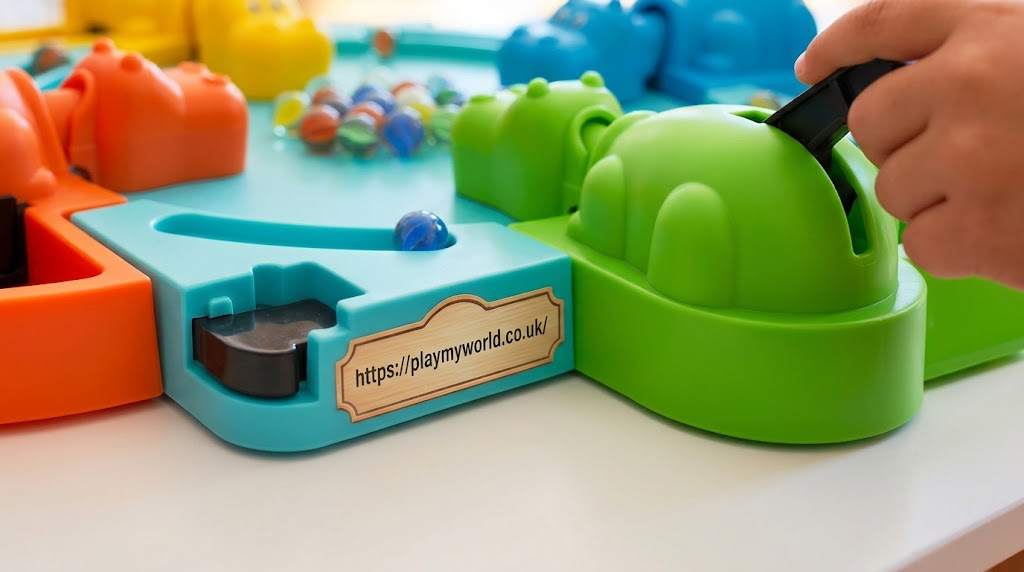
A standard set of hungry hungry hippos contains a central game base that forms the “pond,” four colorful plastic hippos, corresponding levers or tails, approximately twenty plastic marbles (earlier versions sometimes used glass), and instruction materials. Some modern kits include a special colored marble for bonus scoring. The hippos attach to the four corners of the base. Each features a telescoping neck and hinged mouth operated by pressing a lever on the back or tail.
Setup is straightforward. Players place the base on a flat surface with enough room for four people to sit comfortably around it. Hippos are secured into their positions, and marbles are distributed—typically five per player in individual release areas beside each hippo. In newer versions that disassemble for storage, the hippos must first be removed from storage tabs and locked into play position by adjusting the neck and lever mechanisms. Once assembled, the board is ready for immediate action.
Understanding the Hippo Mechanism
Each hippo works through a simple spring-loaded or lever-driven system. Pressing the lever fully extends the neck toward the center of the board while opening the mouth. Releasing the lever retracts the head and closes the jaws. Proper technique requires a complete press-and-release cycle; partial presses often fail to capture marbles effectively. The collected marbles travel beneath the hippo into a personal scoring compartment, allowing easy counting at the end of a round.
Official Rules and Gameplay Modes
Hungry hungry hippos supports two to four players and is recommended for ages four and older. A typical round lasts only a few minutes, making it ideal for short attention spans or repeated plays. The primary objective is straightforward: the player whose hippo collects the most marbles wins.
In the standard or beginner mode, players take turns releasing one marble at a time by pressing a release lever or button. As soon as the marble enters the central pond, all players simultaneously operate their hippos, rapidly pressing and releasing the levers to try to capture it. After a marble is claimed, the next player clockwise releases the subsequent marble. Play continues until every marble has been eaten. Players then empty their scoring areas and count the totals. The highest number claims victory. Ties can be resolved with a quick playoff using a smaller set of marbles.
Advanced and Chaotic Play
The advanced version heightens the excitement by having all players release their marbles simultaneously. On a countdown or signal such as “go,” the entire batch of marbles floods the board at once. Everyone then frantically operates their hippos until the surface is clear. This mode amplifies noise, speed, and competition, often becoming the preferred style among experienced groups. Some households introduce house rules, such as awarding bonus points for a specially colored marble or requiring players to use only one hand.
Strategies and Tips for Success
Although chance plays a significant role because marble trajectories are unpredictable, skillful players improve their results through technique and awareness. Consistent, rapid full presses maximize the number of lunges per second. Timing becomes crucial: observing the bounce and roll of marbles allows a player to anticipate when a marble will enter the hippo’s reach rather than pressing blindly. Slight angling of the hippo toward denser clusters of marbles can increase capture rates.
Practice and Positioning Insights
Familiarity with a specific hippo’s mechanical quirks helps. Some units may extend slightly differently or require firmer pressure. Switching seats between rounds equalizes any minor manufacturing differences. In multi-round sessions, tracking cumulative scores encourages longer engagement. For younger children, adults can slow the pace by releasing marbles more deliberately or reducing the total number used. Keeping the board clean and free of debris ensures smooth neck movement and prevents jams.
Variations and Special Editions
Beyond the classic tabletop version, hungry hungry hippos has inspired numerous adaptations. Compact travel editions replace the large base with a smaller foldable design. Splash or water versions allow outdoor play with floating elements. Arcade redemption machines scale the concept to life-size proportions, complete with ticket payouts. Themed collaborations and limited-color runs appear periodically, keeping collector interest alive. International releases sometimes alter names or packaging while retaining identical mechanics.
Cultural References and Media Appearances
The game has left a noticeable footprint in popular culture. Memorable commercials from the 1980s and 1990s featured catchy songs and dancing cartoon hippos. References appear in television shows, films, and comedy sketches, often used as shorthand for chaotic competition or nostalgic childhood memories. Annual tournaments at gaming conventions and community events further cement its status as more than a simple toy.
Educational and Developmental Benefits
While primarily designed for entertainment, the game offers subtle developmental value. Young players practice hand-eye coordination, fine motor control, and reaction speed. Taking turns in the sequential marble-release mode teaches basic social skills and patience. The short duration prevents frustration, and the clear win condition provides immediate positive reinforcement. Families often use it as an icebreaker or energy-release activity before quieter games.
Maintenance and Longevity Tips
To keep a set functional for years, store it in a dry place and avoid forcing stuck mechanisms. Periodically check that marbles move freely under the hippos and that levers return smoothly. Replacement marbles are sometimes available through the manufacturer or aftermarket sources. Gentle cleaning with a damp cloth removes dust without damaging plastic components. Proper care ensures the satisfying “chomp” sound remains consistent across decades of play.
Hosting Game Nights and Group Play
Hungry hungry hippos works exceptionally well in party settings because rounds are brief and inclusive. Organizers can run elimination brackets or cumulative scoring across multiple heats. Adding thematic decorations or themed snacks enhances the experience. For adult gatherings the advanced all-at-once mode generates lively competition and conversation. Mixing skill levels is easy: experienced players can handicap themselves by using weaker hands or slower presses while newcomers learn the rhythm.
Comparing Editions Over Time
Collectors often debate the merits of original 1970s units versus modern reprints. Vintage sets may feature glass marbles and slightly different plastic molds, while current versions prioritize safety standards, easier assembly, and updated aesthetics. Functionally the gameplay remains nearly identical, proving the strength of the original design. Price points stay accessible, making the game a frequent gift for birthdays, holidays, and family game collections.
FAQs
How many players can participate in hungry hungry hippos?
The standard game supports two to four players, with four offering the most balanced and lively competition.
What is the recommended age range?
Hasbro recommends ages four and older. Younger children can participate with adult assistance for marble release and lever operation.
How long does a typical game last?
Most rounds finish in one to five minutes, allowing multiple plays in a short session.
Are the marbles a choking hazard?
Yes. The game contains small parts and is not suitable for children under three years old without close supervision.
Can the game be played with fewer than four players?
Absolutely. Simply leave unused hippos in place or remove them if the design allows. The remaining players compete for the same pool of marbles.
Is there a single-player mode?
The design focuses on multiplayer competition, but a solo player can practice timing by releasing marbles and operating one hippo against imaginary opponents.
What happens if two players collect the same number of marbles?
A short tiebreaker round using a reduced set of marbles usually resolves the deadlock.
Do different colored hippos have advantages?
No mechanical differences exist between colors. Any perceived advantage comes from player familiarity or minor manufacturing variations.
Conclusion
Hungry hungry hippos continues to thrive nearly five decades after its introduction because it delivers instant fun without demanding complex rules or lengthy setup. From its Japanese-inspired origins brought to the West by Fred Kroll to the countless family living rooms and party tables it has animated, the game remains a pure expression of playful competition. Whether enjoyed in its classic sequential form or the chaotic all-marbles-at-once style, the simple act of operating a plastic hippo to capture rolling marbles creates lasting memories and shared laughter. By understanding its history, mastering basic techniques, and exploring variations, players of all ages can fully appreciate why this marble-munching classic endures as a staple of childhood and nostalgic adult entertainment alike.