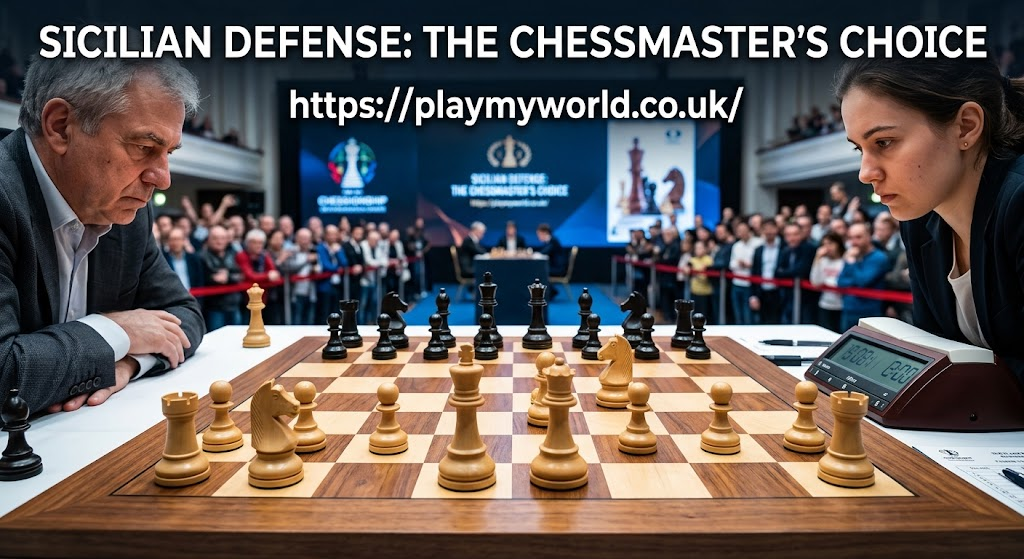
Sicilian Defense: Complete Guide for Chess Players and Strategy Enthusiasts
The Sicilian Defense stands as one of the most dynamic and popular openings in chess. It is the go-to choice for Black against 1.e4 and has been used by world champions and grandmasters for decades. With its sharp, aggressive nature and rich history, the Sicilian Defense offers both tactical fireworks and deep strategic battles. Players of all levels appreciate its flexibility and counter-attacking potential. Whether you are a beginner looking for an exciting way to respond to White’s central push or an advanced player seeking an edge, mastering the Sicilian Defense is essential for any serious chess repertoire.
This comprehensive guide explores every aspect of the Sicilian Defense, from its origins to modern theory, variations, key concepts, and practical tips. By the end, you will have a complete understanding of how to deploy this powerful opening effectively in your games.
What Is the Sicilian Defense?
The Sicilian Defense begins with the move 1.e4 c5. This pawn thrust immediately challenges White’s control of the center and creates an asymmetrical pawn structure from the very first move. Unlike symmetrical openings such as the Ruy Lopez or Queen’s Gambit, the Sicilian Defense ensures that Black never allows White to maintain total central dominance.
The name “Sicilian” comes from the region of Sicily, where this opening was first analyzed in depth by Italian masters in the 19th century. Today, it is the most played defense against 1.e4, appearing in over 30% of games starting with that move. Its popularity stems from the fact that it gives Black excellent counterplay chances while keeping the game sharp and unpredictable.
Historical Background of the Sicilian Defense
The Sicilian Defense traces its roots back to the 16th century, but it was refined in the romantic era of chess. Italian players such as Polerio, Salvio, and later Greco documented early variations. The opening gained prominence in the 19th century when it was played by Wilhelm Steinitz and other world champions.
During the 20th century, the Sicilian Defense became the weapon of choice for Black in world championship matches. Garry Kasparov used it extensively in his matches against Anatoly Karpov, and Boris Spassky employed it in his title-winning games. Today, top players like Hikaru Nakamura, Magnus Carlsen, and Ding Liren regularly feature it in their repertoires.
The opening’s rich history explains why it remains relevant after more than 500 years: it has adapted to every era of chess development while retaining its core aggressive character.
Core Ideas and Strategic Principles in the Sicilian Defense
The Sicilian Defense is built on several fundamental principles that make it attractive to ambitious players:
- Asymmetrical Pawn Structure: By playing c5, Black creates an imbalance that prevents White from achieving a quiet, positional game.
- Central Counterplay: Black often aims to control or attack the d4 square, preparing to undermine White’s center with moves like …d6, …e6, or …Nc6.
- Queenside Initiative: In most lines, Black targets the c-file and prepares queenside expansion with …a6, …b5, or …Rc8.
- Development and Piece Activity: Black focuses on rapid piece development, often fianchettoing the king’s bishop or placing knights on strong outposts.
- Dynamic Tension: The opening maintains constant tension, leading to sharp tactical sequences rather than slow maneuvering.
These principles allow Black to equalize quickly and then seize the initiative, turning the Sicilian Defense into a reliable weapon for fighting for a win from move one.
The Najdorf Variation: The Most Popular and Deep Sicilian Defense
The Najdorf Variation is the most famous and heavily analyzed line of the Sicilian Defense. It arises after the moves 1.e4 c5 2.Nf3 d6 3.d4 cxd4 4.Nxd4 Nf6 5.Nc3 a6.
This move order is beloved because it prevents White from playing Bg5 early and prepares Black’s queenside expansion while supporting the knight on c6. The Najdorf is rich in theory, with numerous sub-variations that have been explored by engines and grandmasters for decades.
Key ideas in the Najdorf include:
- Black developing the knight to f6 and the bishop to g7 or e7.
- Preparing the …b5 break to challenge White’s center.
- Placing the knight on d7 or c6 depending on White’s setup.
- Using the a6 pawn to control b5 and support queenside play.
Grandmasters such as Garry Kasparov, Vishwanathan Anand, and Alexander Grischuk have all employed the Najdorf successfully at the highest level. It remains a top choice even in rapid and blitz formats because it offers both solidity and sharp attacking chances.
The Dragon Variation: A Sharp and Aggressive Sicilian Defense
The Dragon Variation is another classical Sicilian Defense line that leads to extremely sharp and tactical battles. It begins with 1.e4 c5 2.Nf3 d6 3.d4 cxd4 4.Nxd4 Nf6 5.Nc3 g6.
The fianchetto of the king’s bishop on g7 gives Black a powerful long-range piece that exerts pressure along the long diagonal. The opening is named after the famous Dragon-like formation of the black pawns on the kingside.
Strategic features of the Dragon include:
- Black’s bishop on g7 controlling the center and queenside.
- The move …a6 to prevent White’s knight from reaching b5.
- The …d6 and …g6 structure providing a solid but flexible foundation.
- Open play on the c-file and potential kingside attacks.
The Dragon is especially popular in club play and rapid games because it is easy to learn yet offers immediate counter-attacking chances. Many grandmasters, including Viswanathan Anand and Rustam Kasimdzhanov, have used it to score decisive victories.
The Sveshnikov Variation: A Modern Sicilian Defense for Active Players
The Sveshnikov Variation is a modern Sicilian Defense that emphasizes piece activity and piece play over pawn structure. It starts with 1.e4 c5 2.Nf3 Nc6 3.d4 cxd4 4.Nxd4 Nf6 5.Nc3 e5.
This line is known for its dynamic piece play and the “Sveshnikov” hole on d5, which Black often controls with a knight. Black aims for active piece placement rather than a cramped pawn structure.
Key characteristics:
- Early …e5 creates an open center and strong knight outposts.
- Black develops with …Be7 or …Bb4 and often castles kingside.
- The knight on f6 and c6 work together to control central squares.
- White’s attempts to exchange pieces often backfire due to Black’s active pieces.
The Sveshnikov is favored by modern grandmasters such as Teimour Radjabov and Maxime Vachier-Lagrave for its ability to generate winning chances in the middlegame.
The Classical Sicilian Defense: A Solid and Positional Approach
For players who prefer a more positional style, the Classical Variation offers a reliable Sicilian Defense. It typically follows 1.e4 c5 2.Nf3 Nc6 3.d4 cxd4 4.Nxd4 e6.
Black supports the center with …e6 and develops the knight on c6, avoiding the early …d6 of the Najdorf. This line leads to a more closed center and focuses on gradual improvement of piece position.
Strategic highlights include:
- Black’s solid pawn center on d6 and e6.
- Development of the dark-squared bishop to e7 or b4.
- Preparation for queenside castling or kingside castling depending on the line.
- The ability to transpose into various structures based on White’s choice.
The Classical Sicilian Defense is a favorite of players like Levon Aronian and Veselin Topalov for its balance between defense and counterplay.
The Accelerated Dragon and Other Rare Sicilian Defenses
The Accelerated Dragon is a quicker version of the Dragon where Black plays …g6 and …d6 before White can play Nc3. It offers similar sharpness with less theoretical complexity.
Other popular Sicilian Defense lines include the Paulsen Variation, Taimanov Variation, and Scheveningen Variation. Each has its own unique character, allowing Black to choose a style that matches their preferences.
Choosing the Right Sicilian Defense Variation for Your Style
Selecting the correct Sicilian Defense variation depends on your playing style and the level of play:
- For aggressive tactical players, the Dragon or Najdorf offers the best fireworks.
- For modern positional players, the Sveshnikov or Classical lines provide dynamic equality with winning potential.
- For rapid and blitz enthusiasts, the Accelerated Dragon or Sveshnikov are ideal due to their sharpness and shorter theory.
Experimenting with different variations helps you find the one that feels most comfortable and gives you the best practical results.
Common Traps and Tactical Patterns in the Sicilian Defense
The Sicilian Defense is full of traps that can catch unwary White players. One famous pattern involves the knight sacrifice on b5 or the …Nxd4 exchange followed by …Nxe4. Mastering these tactical motifs is crucial for success.
Understanding typical pawn structures and piece exchanges helps Black avoid pitfalls and turn them into winning chances.
Improving Your Sicilian Defense Skills Through Practice
To improve your handling of the Sicilian Defense, follow these practical tips:
- Play against stronger opponents using online platforms to learn from mistakes.
- Study annotated games by top grandmasters who specialize in the opening.
- Analyze your own games with chess engines to identify inaccuracies.
- Play training games focusing on the key ideas of each variation.
Consistent practice will deepen your understanding and increase your confidence in deploying the Sicilian Defenses.
The Role of the Sicilian Defense in Modern Chess Theory
In today’s professional chess scene, the Sicilian Defenses remains one of the most respected weapons for Black. With the help of chess engines, theory has advanced significantly, yet the opening’s dynamic nature ensures that no single line is completely solved. New ideas and refinements appear regularly at the highest level.
Many top players continue to use the Sicilian Defenses because it remains one of the best ways to fight for an advantage against 1.e4.
FAQs About the Sicilian Defense
What is the best Sicilian Defense variation for beginners?
The Accelerated Dragon or Classical Variation is often recommended for beginners because it is easier to learn while still offering sharp play.
How do I play against the Sicilian Defense as White?
White can use the Rossolimo, Alapin, or Grand Prix Attack to challenge Black’s setup. Each has its own advantages and requires careful preparation.
Is the Sicilian Defense good for rapid and blitz chess?
Yes. Variations like the Sveshnikov and Accelerated Dragon are excellent in fast time controls because they allow for quick development and active piece play.
Can I play the Sicilian Defense without studying deep theory?
Absolutely. The opening’s flexibility means that understanding general principles and practicing key ideas is often more important than memorizing long lines.
How do I improve my Sicilian Defense game?
Focus on understanding the pawn structures, practice against strong opponents, and regularly analyze your games with a chess engine.
Is the Sicilian Defense suitable for club players?
Extremely suitable. It offers both winning chances and the chance to learn valuable chess skills through dynamic middlegame battles.
What are the most common mistakes in the Sicilian Defense?
Overextending on the queenside without proper piece support or neglecting kingside development are frequent errors. Always prioritize central control and king safety.
Does the Sicilian Defense lead to drawish games?
No. Most lines are sharp and lead to complex middlegames where the better prepared player usually wins.
Which Sicilian Defense is the easiest to learn?
The Accelerated Dragon is widely considered the simplest due to its shorter theory and clear strategic goals.
Can children or novices use the Sicilian Defense?
Yes. With simplified versions and careful study, even young players can benefit from its aggressive spirit and strategic depth.
Conclusion
The Sicilian Defenses is far more than just a simple response to 1.e4. It is a complete strategic system that offers Black excellent counterplay, dynamic chances, and the potential for both tactical brilliance and deep positional understanding. By mastering the Najdorf, Dragon, Sveshnikov, Classical, and other variations, you equip yourself with a powerful opening that has withstood the test of time and continues to produce exciting games at all levels of play.
Whether you are a club player seeking an aggressive edge or a competitive grandmaster building a world-class repertoire, the Sicilian Defenses deserves a permanent place in your opening library. Its richness, flexibility, and proven track record make it one of the most rewarding choices in chess. Embrace the Sicilian Defenses, and enjoy the thrilling battles it creates on the board.