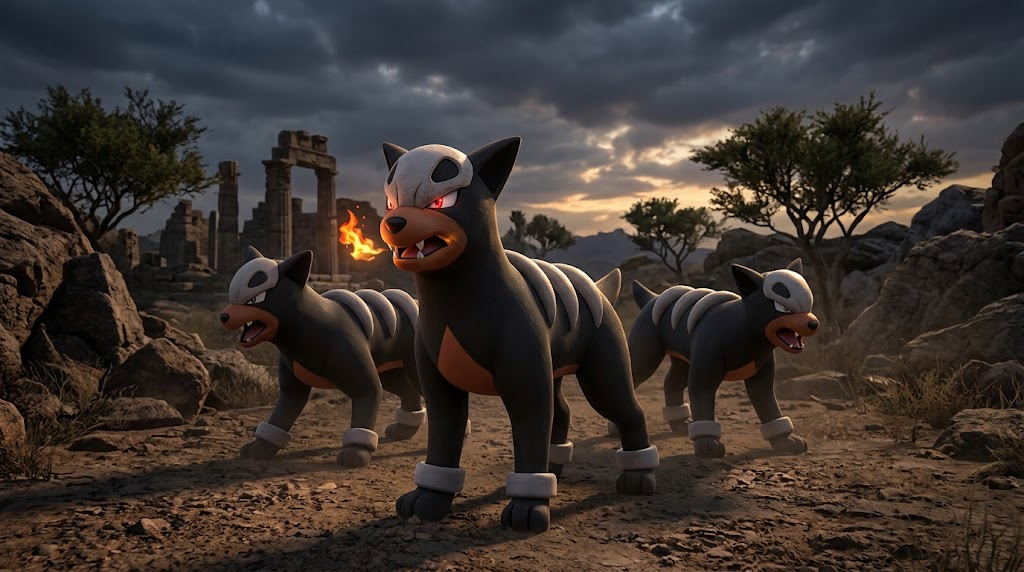
Houndour: The Dark Pokémon That Hunts in Packs and Sets the World Ablaze
Houndour has captured the imagination of Pokémon fans since its debut in Generation 2. This fierce Dark/Fire-type Pokémon embodies loyalty, teamwork, and raw power in the Pokémon world. Whether you are a longtime Trainer discovering it for the first time or a seasoned veteran building your perfect team, Houndour delivers unforgettable battles and memorable moments. In this complete guide, you will explore everything about houndour—from its origins and appearance to its evolution, strategies, and why it remains a fan favorite more than 20 years later.
Introduction to Houndour
Houndour (National Pokédex #228) is a small, menacing canine-like Pokémon with dark fur, glowing red eyes, and a distinctive bone-like crest along its back. Standing at just 0.6 meters tall and weighing 10.8 kilograms, it looks like a pack of wolves guarding sacred fire. Its species name “Dark Pokémon” hints at its intimidating presence and clever hunting instincts. Trainers often choose houndour for its unique ability to combine Dark-type viciousness with the scorching heat of Fire-type attacks, creating a deadly offensive combination that punishes weak defenses.
The Pokémon’s design draws inspiration from real-world wolves and hellhounds, giving it an eerie, almost supernatural vibe. Its Pokédex entry has remained remarkably consistent across generations: it communicates using a variety of cries and hunts in coordinated packs. This teamwork is not just a cute trait—it defines how houndour operates in both the wild and in your own team.
Since its introduction in Pokémon Gold and Silver, houndour has appeared in nearly every major game. It evolved into a reliable ally for Fire- and Dark-type specialists and gained iconic status in competitive battling. Its base friendship is low (35), reflecting its fierce independence, yet it can become incredibly loyal to a dedicated Trainer. That balance of independence and pack loyalty makes houndour feel both wild and deeply personal.
Origin and History in the Pokémon World
Houndour first appeared in the Johto region of Generation 2. Created by Pokémon creators Ken Sugimori and Atsuko Nishida, it quickly became a symbol of the Dark-type’s dark reputation. Unlike many cute starter Pokémon, houndour was designed as a final-stage evolution rather than a baby form, giving it immediate presence and power.
Its evolutionary line has stayed intact through every generation. The game’s continued support shows the Pokémon’s cultural impact. In competitive play, houndour has cycled through formats—from OU in Gen 3 to OU in Gen 4 and still viable in modern Scarlet and Violet eras with the right item and nature. Its persistence proves that solid design and strong typing can carry a Pokémon for decades.
Houndour’s history also ties into the broader Dark-type revival. After years of being overshadowed by Psychic-types, houndour helped remind players that Dark Pokémon can dominate with strategic play. Its history is one of quiet resilience and growing popularity among both casual and competitive fans.
Physical Appearance and Design
The design of houndour is iconic for a reason. It stands on powerful hind legs with a hunched posture, its body covered in sleek black and dark red fur. The most striking feature is the large, flame-shaped crest on its forehead that glows when it is angry or using its Fire-type abilities. Red eyes emit a predatory glow, and its jaws are always slightly open, revealing sharp fangs.
Its tail ends in a sharp point that can be used for balance during leaps or as a weapon in combat. The Pokémon’s overall silhouette gives off an aggressive, wolf-like presence that intimidates opponents on sight. In battles, houndour often stands its ground, letting enemies feel the heat and darkness before striking.
Shiny versions of houndour transform the design into a fiery orange with glowing yellow eyes and a more dramatic crest. The shiny variant feels even more menacing, making it a favorite for collectors and competitive trainers who love flashy aesthetics.
Personality and Behavior of Houndour
Houndour is a creature of loyalty and cunning. It does not hunt alone; instead, it uses coordinated packs to corner prey. Trainers who study its Pokédex entries quickly realize this pack intelligence is real. In the wild, houndour uses unique howls and barks that only members of its group understand, allowing perfect communication during hunts.
Its personality leans toward independence. It values its own instincts over strict orders, yet once it bonds with a Trainer, it becomes fiercely protective. In battle, houndour often opens with a leer to intimidate or a Flamethrower to set the stage on fire. It thrives in aggressive, fast-paced battles where it can strike first and hardest.
Many fans note that houndour reminds them of loyal but fiery companions—think a werewolf who refuses to abandon its pack. This combination of aggression and loyalty makes it memorable both as a wild Pokémon and as a teammate.
Evolution: From Houndour to Houndoom
The evolution line for houndour is straightforward yet powerful. At level 24, houndour evolves into Houndoom. The transformation is dramatic: the new form stands taller, its body thicker and more muscular, with a larger crest that burns brighter and a more menacing scowl. Houndoom’s design perfectly captures the concept of a dark lord of the underworld—powerful, elegant, and terrifying.
The evolution preserves all core typing (Dark/Fire) while increasing base stats significantly. HP rises to 75, Attack to 90, Special Attack to 110, and Speed jumps to 95. The new total base stat total reaches 500, making Houndoom a genuine powerhouse. Many competitive builds now favor Mega Houndoom, which gains even higher stats and can break through almost anything.
The evolution is not just a stat boost—it represents growth. Houndour matures into a leader, its pack instincts amplified into something far more dangerous. Trainers who wait for the right level gain a Pokémon that can sweep entire teams.
Typing, Abilities, and Weaknesses
Houndour is a Dark/Fire dual-type. This combination gives it excellent offensive coverage against Psychic, Ghost, and Steel types while providing Fire-type STAB (same-type attack bonus) for its own moves. Dark typing adds nasty plots, crunch, and dark pulse to its arsenal.
Primary Ability: Early Bird
This ability makes the Pokémon wake up from sleep twice as fast. Perfect for Trainers who like to keep their Pokémon awake during long battles or sleep status effects.
Secondary Ability: Flash Fire
Houndour absorbs Fire-type moves directed at it and stores the flames, powering up its own Fire attacks by 50%. This creates devastating combos with moves like Overheat or Fire Blast. Many players build around this ability for surprise counters.
Hidden Ability: Unnerve
This ability prevents opposing Pokémon from eating held berries. In competitive play, it disrupts stall strategies and supports sweeping teams that want to land critical hits.
Weaknesses are straightforward: Water (x2), Fighting (x2), Ground (x2), and Rock (x2). Psychic-type moves hit super effectively, so smart opponents will bring Fighting, Ground, or Rock Pokémon to counter. However, Houndour’s resistances to Fire, Grass, Ice, Dark, Ghost, and Steel, plus its immunity to Psychic, make it difficult to take down completely.
Base Stats and Role in Battle
Houndour’s base stats reflect its balanced design. At 330 total, it sits in the lower tiers but punches above its weight with proper investment. Special Attack sits at 80 while Speed sits at 65—enough to outspeed many common threats when boosted. The low Defense (30) means it needs careful play, but the high Special Attack and Speed allow it to threaten from range.
In older generations, houndour was a solid OU threat. Today, it remains viable in formats like Scarlet and Violet with items such as Choice Band or Life Orb and natures like Timid or Modest. Its role is primarily offensive: setting up Nasty Plot, sweeping with Flamethrower and Crunch, or using Flash Fire to boost its own power.
Best Movesets for Houndour
A well-rounded moveset turns houndour into a terrifying force. Here are popular options:
Standard Competitive Set (Level 50+)
- Flamethrower (STAB, 90 power, 100% accuracy)
- Crunch (Dark STAB, 80 power, 100% accuracy)
- Dark Pulse (STAB, 80 power, 80% accuracy)
- Will-O-Wisp (status, 100% accuracy)
This set pressures Psychic and Steel types while providing reliable status and damage. Mega Houndoom can run more powerful options like Overheat.
Sweeper Build
- Overheat (STAB Fire, 130 power)
- Crunch
- Dark Pulse
- Nasty Plot (boosts Special Attack dramatically)
This build relies on Flash Fire and Superpower items for massive damage output.
VGC or Doubles Set
- Flamethrower
- Crunch
- Taunt
- Protect
Taunt prevents opponents from setting up, making it excellent for controlling matches.
Each moveset rewards preparation. Trainers who understand Houndour’s typing will always bring counters, but smart play turns those weaknesses into opportunities.
Where to Find Houndour in the Games
Houndour appears in many locations across the Pokémon series. Ins early games like Gold and Silver, it can be found at night on Route 7. In Diamond and Pearl, it appears in the Sinnoh region’s mountainous areas during specific times. In the newer Scarlet and Violet games, houndour can be encountered in the Lumiose City area or through specific events.
Trainers also breed Houndour from compatible parents or use trading to obtain rare shiny versions. In Legends: Arceus and Legends: Z-A, houndour returns in new regions with unique behaviors, adding fresh hunting mechanics and pack coordination mechanics.
How to Catch Houndour and Raise It
Catching houndour requires patience. It is relatively common but often found in areas with Fire-type encounters or at night. Use a well-baited Poké Ball and ensure the Pokémon is at low health for the best capture rate.
Raising houndour is straightforward. It learns quickly and benefits from the right nature and items. Early Bird lets it recover faster from sleep status, while Flash Fire turns defensive play into aggressive offense. Give it a Life Orb or Choice Band for maximum damage, and watch it dominate matches.
Houndour in the Competitive Scene
In competitive battling, houndour has cycled through formats but always finds a home. Ins Gen 3 and Gen 4, it was a staple in OU and Uber tiers. In recent generations, Mega Houndoom still sees play, especially in doubles formats. Its typing gives it unique advantages that many other Dark/Fire Pokémon lack.
Trainers love building around Houndour because it rewards skill. Flash Fire turns normal Fire moves into hidden power-ups, and Dark typing adds coverage against common threats. Many top players still use houndour successfully in modern tournaments, proving its timeless appeal.
Cultural Impact and Popularity
Houndour has become a cultural icon within the Pokémon community. Its design appears on merchandise worldwide, and fans often create fan art, cosplay, and memes about its fiery howls. The Pokémon’s pack loyalty and fierce personality resonate with trainers who want a strong, independent companion.
In the anime and manga, houndour occasionally appears as a rival or ally, adding to its lore. Its presence in spin-off games like Mystery Dungeon and Ranger further solidifies its status as a beloved Dark-type.
Fun Facts About Houndour
- Houndour uses over 100 different cries to communicate and hunt.
- It never abandons a wounded pack member, showing incredible loyalty.
- The Pokédex entry about dawn howls announcing territory is still referenced in modern games.
- Shiny Houndour’s glowing crest is one of the most popular shiny designs in the series.
- Its hidden ability Unnerve is perfect for berry-denying stall counters.
These little details make houndour feel alive and special.
FAQs About Houndour
What is the best ability for Houndour?
Flash Fire is widely considered the best for competitive play because it powers up Fire moves. Early Bird is excellent for stall or sleep-heavy strategies. Unnerve shines in doubles or when disrupting berry teams.
How does Houndour evolve?
Houndour evolves into Houndoom at level 24. The evolution is permanent and cannot be reverted. Mega Houndoom evolves from regular Houndoom when holding a Houndoominite.
Is Houndour weak to any particular type?
It is weak to Water, Fighting, Ground, and Rock. Its Psychic immunity and resistances to Fire, Grass, Ice, Dark, Ghost, and Steel make it harder to handle than most Dark-types.
Can Houndour be bred?
Yes, Houndour can be bred from compatible parents. Common egg moves include Fire Spin, Pursuit, and Beat Up, which trainers often chain-breed onto the line.
What is the best moveset for Houndour in Scarlet and Violet?
A strong set includes Flamethrower, Crunch, Dark Pulse, and Will-O-Wisp. For Mega forms, Overheat and Nasty Plot become devastating.
Does Houndour appear in all Pokémon games?
It appears in nearly every mainline title since Generation 2, including remakes, spin-offs, and the latest Scarlet and Violet games.
Is Houndour good for beginners?
Its straightforward typing and abilities make it accessible, but competitive play requires understanding its weaknesses. For casual play, it is perfect for Fire- or Dark-type teams.
How rare is Houndour?
It is not extremely rare but can be found in specific locations. Shiny versions are rarer and highly sought after by collectors.
Can Houndour learn any status moves?
Yes, it learns Will-O-Wisp, Taunt, and more. These status options are crucial for controlling opponents in competitive battles.
Conclusion
Houndour stands as a testament to what makes Pokémon great: a perfect blend of fierce design, deep lore, and strategic depth. From its dark fur and glowing eyes to its pack-hunting instincts and powerful evolutions, this Pokémon delivers everything fans love. Whether you are catching it in the wild, building a competitive team, or simply enjoying its howls at dawn, houndour brings energy and excitement to every encounter.
The journey of houndour is far from over. As new games release and classic titles get remakes, this Dark/Fire-type will continue to evolve alongside its Trainers. If you have not met houndour yet, now is the perfect time. Its loyalty, power, and unforgettable personality make it one of the most memorable Pokémon in the entire series. Pack up your Poké Balls and prepare for the night—houndour is waiting.