Gen 6 Pokémon: A Deep Dive into the Mega Evolution Era of the Pokémon Franchise
Pokémon has been captivating fans worldwide since its launch in 1996, evolving from simple sprite-based games to sophisticated 3D adventures. Gen 6 Pokémon marked a pivotal moment in the series, introducing full 3D graphics and groundbreaking mechanics that transformed how players interact with the Pokémon world. Released for the Nintendo 3DS, Generation 6—specifically Pokémon X and Pokémon Y—brought the franchise into a new era of visual splendor and strategic depth. This comprehensive guide explores the history, features, new Pokémon, gameplay innovations, and legacy of Gen 6 Pokémon, ensuring you have all the insights needed to appreciate this iconic generation.
The Announcement and Release of Gen 6 Pokémon
Nintendo’s January 2013 Pokémon Direct announcement ignited excitement across the gaming community. Hosted by Satoru Iwata, the event revealed Pokémon X and Pokémon Y as the first full 3D entries in the series. Unlike previous generations that relied on 2D sprites, these titles delivered breathtaking landscapes, dynamic camera angles, and immersive environments that felt alive.
The games launched on October 12, 2013, in Japan and October 26, 2013, in North America and Europe. Gen 6 Pokémon quickly became a phenomenon, selling millions of copies and setting the stage for future 3D adventures. The Kalos region, inspired by France, offered vibrant cities, lush forests, and dramatic mountains, providing a perfect backdrop for trainers to embark on their journey.
The Kalos Region: A Visual Masterpiece
Kalos is not just a setting—it is a character in its own right. From the bustling Lumiose City with its neon lights and bustling streets to the serene Laverre City, every location in Gen 6 Pokémon shines with new 3D models and detailed textures. Players can explore routes filled with tall grass where wild Pokémon roam, hidden caves containing rare species, and towering mountains that host powerful legendaries.
The region’s design drew heavy inspiration from European architecture and culture, creating a sense of wonder. Players can customize their avatar’s style in Lumiose City, changing outfits and hairstyles, adding a personal touch to the experience. This attention to visual detail made Gen 6 Pokémon stand out, proving that the series could compete with modern open-world games in terms of immersion.
New Pokémon in Gen 6 Pokémon
Gen 6 Pokémon introduced 72 brand-new species, expanding the Pokédex significantly. These Pokémon range from adorable starters to powerful legendaries, each with unique designs, abilities, and roles. Here are some highlights:
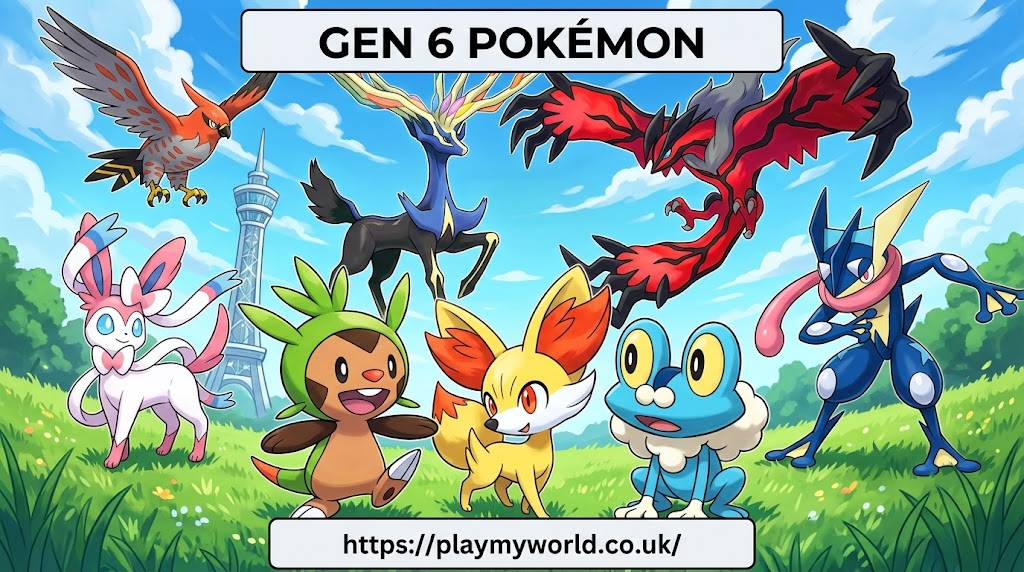
- Chespin, Fennekin, and Froakie: The new Grass-, Fire-, and Water-type starters bring fresh gameplay options. Chespin’s Bulletproof ability protects it from direct attacks, while Fennekin’s Blaze ability boosts Fire moves at low HP. Froakie’s Torrent ability powers up Water attacks similarly.
- Mega Evolutions: A signature feature of Gen 6 Pokémon allows certain Pokémon to Mega Evolve during battle using Mega Stones. This changes their stats, moves, and sometimes their types. For example, Charizard can become Mega Charizard X or Y, gaining massive boosts to Attack or Special Attack. Greninja, the Water/Dark final evolution of Froakie, gains powerful moves like Water Shuriken and Night Slash.
- Legendaries: Xerneas and Yveltal are the central legendary pair. Xerneas brings life and regeneration, while Yveltal represents destruction. Zygarde, introduced later in the expansion pack, is a legendary guardian of the Kalos ecosystem.
Other notable additions include Hawlucha, a Fighting/Flying type with incredible agility, and Carbink, a Rock/Fairy-type that evolves into the massive diorite Guardian.
Gameplay Innovations in Gen 6 Pokémon
Gen 6 Pokémons revolutionized battle systems. Mega Evolution became the star mechanic, requiring a Key Stone to activate and a Mega Stone to power up. This added layers of strategy, as trainers must choose when and how to deploy Mega Pokémon. The Battle Maison offers competitive challenges where players can earn Battle Points for rare items.
O-Powers provide temporary boosts like Exp. Share or EV boosters, making progression smoother. The Super Training feature lets players raise individual Pokémon stats through mini-games, rewarding dedication.
The Kalos League, the final gym challenge, tests your team against the region’s best trainers. Completing it grants the Champion title and access to additional content like the Battle Subway for endless battles.
Story of Gen 6 Pokémon
The story follows a young trainer journeying through Kalos. They meet Professor Sycamore, who discovers a mysterious pattern in Pokémon behavior. The plot deepens when the player encounters AZ, a 3000-year-old man who created the ultimate weapon using ancient Pokémon technology. Team Flare, led by Lysandre, seeks to use this weapon to “fix” the world by eliminating 90% of humanity.
Gen 6 Pokémons explores themes of beauty, destruction, and redemption. The climax involves confronting AZ and stopping the Ultimate Weapon’s deployment. The narrative blends adventure, mystery, and emotional depth, making it one of the most memorable stories in the series.
Mega Evolutions: The Heart of Gen 6 Pokémon
Mega Evolution defined Gen 6 Pokémons. It is a special battle form that occurs once per battle. Each eligible Pokémon has a unique Mega form, and the evolution process is tied to the trainer’s bond with their partner.
Key Mega Pokémon include:
- Mega Charizard X: Fire/Dragon with huge Attack
- Mega Charizard Y: Fire/Flying with huge Special Attack
- Mega Garchomp: Dragon/Ground with massive Attack
- Mega Lucario: Fighting/Steel with boosted stats
This system encouraged experimentation in battles, with many players building teams around specific Mega evolutions. The expansion packs Omega Ruby and Alpha Sapphire later introduced Primal Reversion, further expanding the concept.
Competitive Play and Battle Features in Gen 6 Pokémon
The competitive scene flourished thanks to Mega Evolution. Online battles, the Battle Subway, and the Battle Maison provided platforms for players to test skills. The games introduced new battle mechanics like Fairy-type moves (introduced in this generation), which are super-effective against Dragon and Fighting types.
Players can trade Pokémon freely, participate in wireless events, and even customize their team visually in the style options menu. The games’ online features allowed for social interaction, with players forming teams and competing in global leaderboards.
The Expansions: Omega Ruby and Alpha Sapphire
Pokémon Omega Ruby and Alpha Sapphire were released in November 2014 for 3DS. These remakes of Ruby and Sapphire brought the Hoenn region into 3D while adding new content. Mega Evolution returned, and players could catch all Pokémon from previous generations.
Primal Reversion allowed Groudon and Kyogre to revert to their primal forms, gaining massive power boosts. The Delta Episode added Zygarde to the story, and the new Z-Move system (tied to Z-Crystals) introduced powerful final moves. These expansions enhanced Gen 6 Pokémonsq by offering a complete experience with updated graphics and new legendaries.
Impact on the Pokémon Series
Gen 6 Pokémons set a new standard for the franchise. Full 3D graphics became the norm, influencing all subsequent titles. The introduction of Fairy-type Pokémon, Mega Evolution, and the Kalos region left a lasting mark. Many players cite Gen 6 Pokémons as the peak of 3D-era Pokémon games due to its balance of accessibility and depth.
The games also boosted the franchise’s popularity, leading to more merchandise, anime episodes, and spin-offs. Later generations built upon these innovations, making Gen 6 Pokémons a foundational era.
Popular Gen 6 Pokémon for Beginners and Experts
For new players, start with Greninja, known for its speed and Water Shuriken. Chespin or Froakie make excellent partners due to their typing advantages. For competitive players, Mega Charizard Y remains a staple for Fire coverage.
Experienced trainers appreciate the variety in Gen 6 Pokémons lineups. Hawlucha excels in mixed attackers, while Carbink provides solid Rock typing. Zygarde, in its 50% Forme, offers great defensive utility.
How to Play Gen 6 Pokémon Today
Modern emulation or virtual console access allows fans to relive Gen 6 Pokémons on any device. Community resources provide ROMs and save editors, though official re-releases are rare. The games’ online features still work in many regions, letting players battle others or trade.
Fans can also enjoy the story through the Pokémon anime, where Ash battles with Kalos Pokémon like Greninja and goodra. The games’ soundtrack, composed by Junichi Masuda, remains one of the best in the series.
Future of Gen 6 Pokémon and the Franchise
Although Gen 6 Pokémons concluded its initial run in 2016 with the release of Sun and Moon, the concepts it introduced continue to influence modern games. Mega Evolution returned in later titles, and full 3D is now standard. Fans still speculate about remakes or expansions featuring Kalos Pokémon.
The legacy of Gen 6 Pokémons lies in its innovation. It proved that the Pokémon series could evolve creatively while keeping core appeal intact.
FAQs
What is Gen 6 Pokemon?
Gen 6 Pokemon refers to the sixth generation of the Pokémon video game series, released in 2013 for the Nintendo 3DS. It includes Pokémon X and Pokémon Y, along with their remakes Omega Ruby and Alpha Sapphire. This generation is famous for its full 3D graphics, the innovative Mega Evolution system, and the beautiful Kalos region.
When was Gen 6 Pokemon released?
The main games Pokémon X and Pokémon Y launched on October 12, 2013, in Japan and October 26, 2013, in North America and Europe. The expansions Omega Ruby and Alpha Sapphire followed in November 2014.
How many new Pokémon did Gen 6 Pokemon introduce?
Gen 6 Pokemon added 72 brand-new Pokémon to the Pokédex. This includes the starters Chespin, Fennekin, and Froakie, as well as legendaries like Xerneas, Yveltal, and Zygarde.
What is Mega Evolution in Gen 6 Pokemon?
Mega Evolution is a special battle form introduced in Gen 6 Pokemon. Certain Pokémon can transform into a more powerful Mega form using a Mega Stone and a Key Stone. It changes stats, moves, and sometimes types, adding deep strategy to battles.
Which Pokémon are the best in Gen 6 Pokemon?
Popular choices include Greninja (fast Water/Dark attacker), Mega Charizard Y (Fire/Flying sweeper), Hawlucha (agile Fighting/Flying), and Zygarde in 50% Forme (defensive legendaries). Every player finds a favorite in Gen 6 Pokemon!
Can I play Gen 6 Pokemon today?
Yes! Emulation, virtual console, or ROM access allows fans to enjoy Gen 6 Pokemon on modern devices. Online trading and battling still work in many regions, and the Pokémon anime features the games’ stars.
Is there a Gen 6 Pokemon remake?
No official remake exists yet, but the games remain popular through emulation and fan communities. Many players hope for future re-releases featuring Kalos Pokémon.
What new type was introduced in Gen 6 Pokemon?
The Fairy type was introduced in Gen 6 Pokemons. It is super-effective against Dragon and Fighting types and weak to Poison and Steel types.
Conclusion
Gen 6 Pokémons remains one of the most beloved generations in the franchise. With its stunning visuals, revolutionary Mega Evolution system, rich story, and memorable new Pokémon, Gen 6 Pokémons delivered an unforgettable experience for millions of trainers. From the vibrant Kalos region to the epic battles in the Kalos League, this era redefined what players expect from the series.
Whether you are a longtime fan or a newcomer discovering Gen 6 Pokémons, this generation offers something for everyone. Its innovations paved the way for future adventures, and its charm endures today. The Pokémon journey continues, but Gen 6 Pokémons will always hold a special place in the hearts of those who lived through the 3D revolution.