Connectivity Issues HSSGamepad: The Ultimate Troubleshooting Guide
Wireless gaming controllers like the HSSGamepad offer freedom and convenience, but connectivity issues hssgamepad can quickly turn an enjoyable gaming session into a frustrating experience. Whether you’re facing pairing failures, random disconnections, input lag, or the controller not being detected at all, these problems are common with many budget wireless gamepads. This comprehensive 3000-word guide covers every aspect of diagnosing and resolving connectivity issues hssgamepad, with detailed steps, platform-specific advice, and prevention strategies to help you get back to smooth gameplay.
What Is the HSSGamepad and Why Do Connectivity Problems Occur?
The HSSGamepad is a versatile wireless controller supporting Bluetooth and sometimes 2.4GHz dongle modes. It works across PC, Android, iOS, and other platforms, featuring ergonomic design, responsive buttons, and decent battery life. However, like many wireless devices, it relies on stable Bluetooth signals, proper power management, and clean pairing data.
Connectivity issues hssgamepad typically stem from environmental factors, user errors, software conflicts, or hardware limitations. Understanding these helps you troubleshoot efficiently rather than guessing randomly. Many users report issues after OS updates, in crowded wireless environments, or with low battery levels.
In this article, we’ll explore symptoms, root causes, fixes, and long-term solutions. By the end, you’ll have a complete toolkit to resolve most problems.
Common Symptoms of Connectivity Issues HSSGamepad
Recognizing the exact problem narrows down solutions quickly. Here are the most reported symptoms:
Bluetooth Pairing Failures
The controller doesn’t appear in your device’s Bluetooth list, or it shows up but pairing fails or times out. LEDs may blink but never connect solidly.
Random Disconnections
The gamepad pairs successfully but drops during gameplay, often mid-session. This disrupts immersion in fast-paced games.
Input Lag or Delayed Response
Button presses or stick movements register with noticeable delay, affecting precision in competitive titles.
Controller Not Detected
No response at all, even in wired USB mode. Games or the OS fail to recognize the device.
Intermittent or Unresponsive Buttons
Partial functionality where some inputs work while others don’t, or ghost inputs occur.
These symptoms often overlap, so systematic troubleshooting is essential.
Root Causes Behind Connectivity Issues HSSGamepad
Several factors contribute to these problems. Identifying the cause saves time.
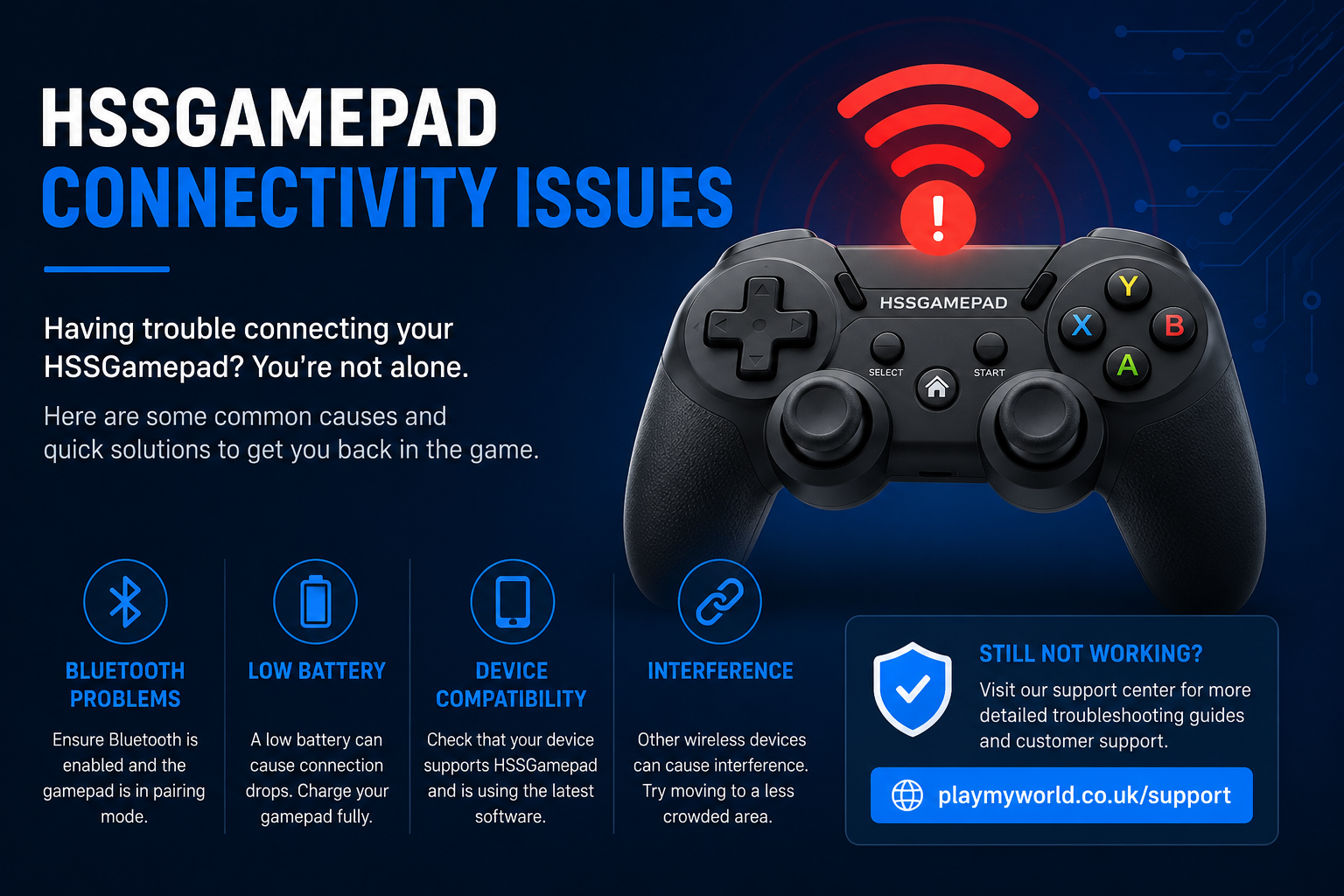
Low or Unstable Battery Power
Low battery is the top culprit. Below 20% charge, Bluetooth signal weakens, causing drops, lag, and pairing failures. Even if the indicator shows okay, voltage drops affect performance. Rechargeable models need full charges; AA battery versions require fresh, high-quality cells.
Wireless Interference
Bluetooth operates on the 2.4GHz band, shared with Wi-Fi routers, microwaves, cordless phones, and other devices. Dense environments amplify issues.
Corrupted Pairing Data
Stored pairing info on the controller or host device becomes outdated or conflicting after multiple connections.
Outdated Firmware, Drivers, or OS
Firmware mismatches after device updates cause compatibility problems. Bluetooth drivers on PCs often need refreshing.
Incorrect Pairing Mode or Distance
Using the wrong mode (e.g., Android vs. PC) or operating beyond optimal range (typically under 3-6 feet for stable Bluetooth) leads to failures.
Power Management Settings
Modern devices aggressively save battery by throttling Bluetooth, leading to disconnections.
Hardware Factors
Faulty cables, dirty ports, or manufacturing defects (less common but possible in budget controllers).
Connectivity issues hssgamepad3 often trace back to a combination of these, especially battery and interference.
Step-by-Step Basic Troubleshooting for Connectivity Issues HSSGamepad
Start here—most issues resolve with these simple steps.
Step 1: Fully Charge the Controller
Connect via USB-C and charge for at least 45-60 minutes, ideally to 100%. Do not test while charging, as it can interfere with wireless signals. For AA models, replace with new batteries.
Step 2: Restart Everything
Power off the controller, restart your PC/phone/console, and toggle Bluetooth off/on. This clears temporary glitches.
Step 3: Clear Pairing Data and Re-Pair
- On your device: Go to Bluetooth settings, forget/remove the HSSGamepad entry.
- On the controller: Hold the pairing/Home button until the LED flashes rapidly (indicating discovery mode). Some models require holding Home + another button (e.g., X for Android mode).
- Stay within 1 meter during pairing.
Step 4: Reduce Interference
Move away from Wi-Fi routers, turn off nearby Bluetooth devices, and test in a quieter area. Use 5GHz Wi-Fi if possible to free up 2.4GHz.
Step 5: Test Wired Mode
Switch to USB connection for stability. Use a quality data cable (not charge-only). This bypasses wireless problems entirely for troubleshooting.
Fixing Specific Connectivity Issues HSSGamepad
Resolving Bluetooth Pairing Failures
If pairing fails repeatedly:
- Ensure correct mode: Check manual for platform-specific button combos.
- Perform a hard reset: Use the pinhole reset button on the back with a paperclip for 5-15 seconds.
- Update your device’s Bluetooth stack via OS settings or manufacturer tools.
- Avoid multiple paired devices overwhelming the controller’s memory.
Connectivity issues hssgamepad3 in pairing are often fixed by resetting and re-pairing fresh.
Stopping Random Disconnections
- Maintain battery above 30%.
- Disable battery optimization for Bluetooth on Android (Settings > Apps > Special Access).
- On Windows, update Bluetooth drivers via Device Manager.
- Keep the controller within optimal range and minimize obstructions.
Eliminating Input Lag
- Switch to 2.4GHz dongle mode if available (lower latency than Bluetooth).
- Close background apps consuming resources.
- Calibrate the controller in game settings or OS control panel.
- For PC, ensure X-Input mode compatibility where supported.
Platform-Specific Solutions
Windows PC
- Open Device Manager > Update/reinstall Bluetooth and HID drivers.
- Run Hardware Troubleshooter.
- Check for Windows updates.
- Use USB ports directly on the motherboard.
Android Devices
- Disable battery optimization specifically for the controller.
- Use Airplane Mode briefly then re-enable Bluetooth.
- Ensure Android version supports required Bluetooth profiles.
- OTG adapter for wired testing.
iOS / macOS
- Forget device in Bluetooth settings.
- Restart device.
- Check for iOS/macOS updates.
- Some apps may need additional permissions.
Other Consoles
Follow device-specific pairing instructions, often involving specific button sequences.
Advanced Troubleshooting for Persistent Connectivity Issues HSSGamepad
If basics fail, go deeper:
Firmware Updates
Connect to a PC and check for official HSSGamepad software or apps (if available) to update firmware. This resolves many compatibility bugs.
Driver Reinstallation
On Windows, uninstall the device completely in Device Manager, then restart to reinstall fresh.
Interference Analysis
Use Wi-Fi analyzer apps to identify crowded channels. Relocate your router or gaming setup.
Testing on Another Device
Isolate whether the issue is with the controller or host. If it works elsewhere, focus on host settings.
Calibration and Button Mapping
Use tools like Steam’s controller configuration or third-party software (where appropriate) to remap and calibrate.
Connectivity issues hssgamepad3 persisting may indicate a need for firmware or hardware checks.
Prevention Tips to Avoid Future Connectivity Issues HSSGamepad
- Keep battery charged regularly—avoid letting it drop below 20%.
- Store the controller away from heat and moisture.
- Update your devices and controller firmware promptly.
- Use a dedicated 2.4GHz dongle when available for gaming.
- Maintain a clean environment with minimal wireless clutter.
- Invest in quality USB cables for wired fallback.
- Periodically clear old pairings to prevent data corruption.
Regular maintenance extends the life of your controller and minimizes disruptions.
Optimizing Your Gaming Setup for Reliable HSSGamepad Performance
Beyond fixes, optimize your overall setup:
- Position the host device and controller for line-of-sight.
- Use wired Ethernet for your router to reduce Wi-Fi load.
- Close unnecessary background processes.
- Consider signal boosters or better router placement for larger spaces.
- Monitor temperature—overheating can affect electronics.
These habits turn occasional connectivity issues hssgamepad into rare events.
Frequently Asked Questions (FAQs) About Connectivity Issues HSSGamepad
What causes connectivity issues hssgamepad most often?
Low battery, wireless interference, and corrupted pairing data are the primary causes. Start troubleshooting with a full charge and re-pairing.
How do I fix HSSGamepad that won’t pair?
Fully charge it, forget the device on your host, reset the controller via pinhole if available, enter pairing mode (rapid LED flash), and try again close-range.
Why does my HSSGamepad disconnect randomly?
Common reasons include low power, interference, or aggressive battery saving on the host device. Disable optimizations and reduce nearby signals.
Is input lag normal with HSSGamepad?
Some lag can occur in Bluetooth mode, but switching to wired or 2.4GHz dongle usually resolves it. Update drivers and firmware too.
Can I use HSSGamepad wired to bypass wireless problems?
Yes—USB mode is highly reliable for troubleshooting and stable play. Ensure a proper data cable.
How long should I charge the HSSGamepad?
At least 45-60 minutes for a full charge. Avoid playing while charging initially.
Does distance affect connectivity issues hssgamepad3?
Yes—stay within 3-6 feet for best Bluetooth performance. Walls and obstacles degrade signals.
What if nothing fixes my connectivity issues?
Test on another device. If hardware fault suspected, check warranty options.
Are firmware updates necessary?
Yes, especially after OS updates on your main device. They fix bugs and improve stability.
How do I prevent future problems?
Regular charging, interference management, and keeping software updated go a long way.
Conclusion
Dealing with connectivity issues hssgamepad doesn’t have to ruin your gaming experience. By following this detailed guide—from basic power checks and re-pairing to advanced firmware updates and platform tweaks—you can resolve most problems quickly and enjoy reliable performance from your HSSGamepad. Remember, prevention through proper care and setup is key to long-term satisfaction.
Whether you’re a casual player or competitive gamer, a stable connection makes all the difference. Apply these steps systematically, test after each change, and you’ll minimize downtime. Happy gaming, and may your controller stay connected through every intense session!